The Symphony of Design
Cape Cod Home / Spring 2026 / Home, Garden & Design
Writer: Julie Craven Wagner / Photographer: Andrew Frasz
The Symphony of Design
Cape Cod Home / Spring 2026 / Home, Garden & Design
Writer: Julie Craven Wagner / Photographer: Andrew Frasz
In a historic Cohasset sea captain’s home, designer Corey Damen Jenkins orchestrates a rich interplay of color, texture, and tone for a modern family.
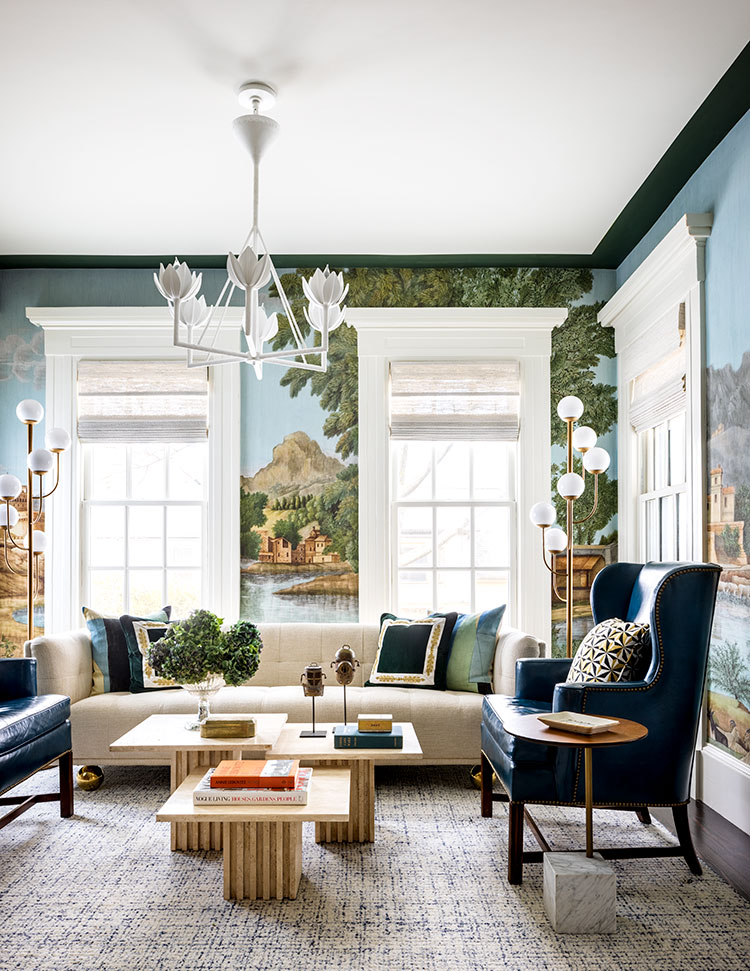
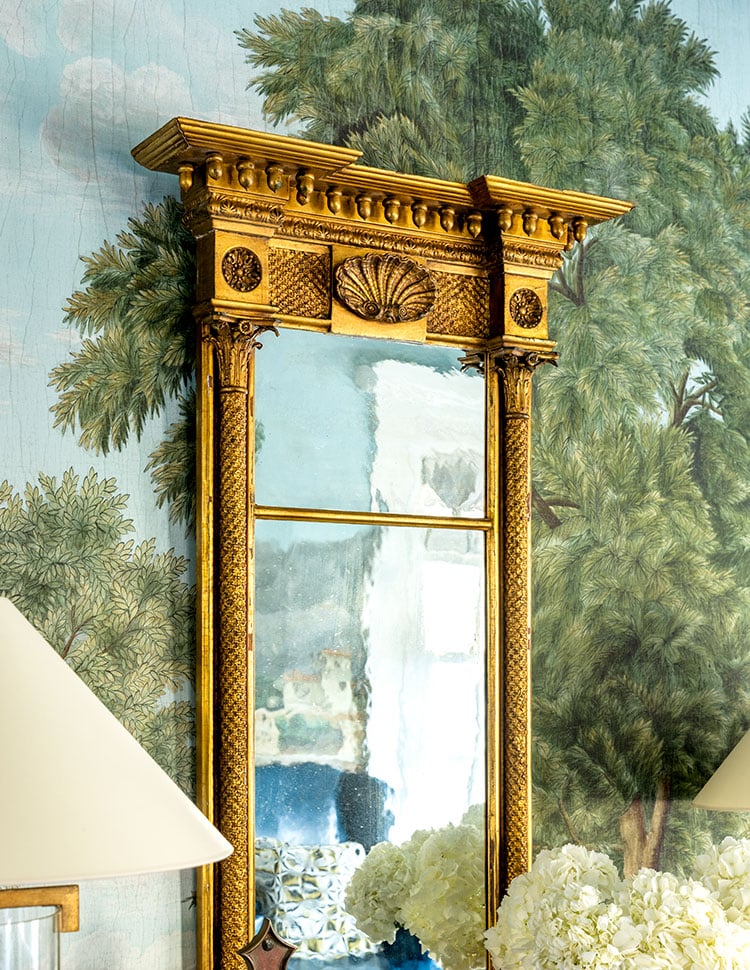
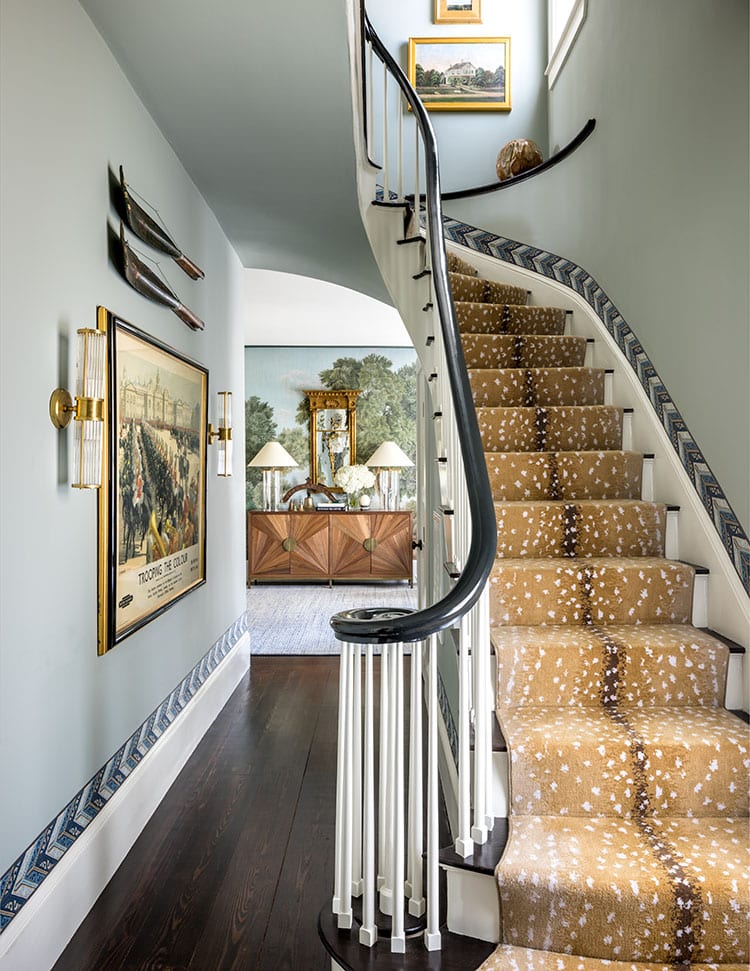
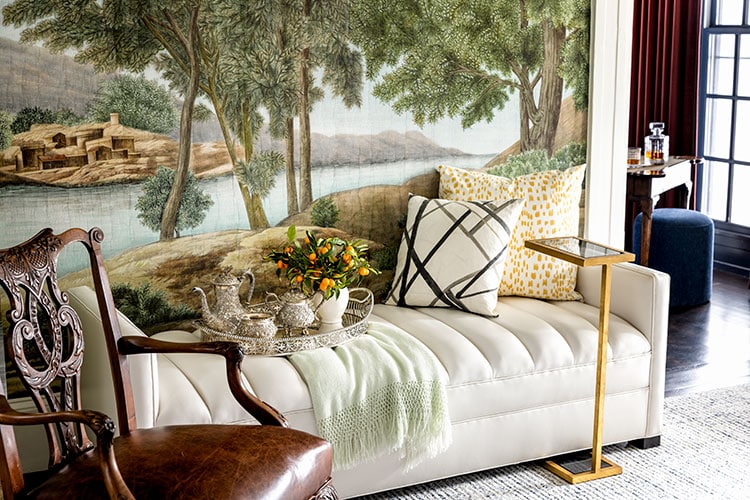
From the moment one steps inside the stately 19th-century sea captain’s home in Cohasset, it becomes clear that this is no ordinary exercise in preservation. The transition from the expansive front porch into the modest foyer is brief, almost deceptively so, before the home reveals its true character in a sweeping front-to-back parlor—a room that immediately envelops the senses. Every wall is wrapped in a pastoral mural, its verdant landscape unfolding in quiet detail, setting the tone for a home where design is not simply applied, but composed. It is here, in this richly layered introduction, that Corey Damen Jenkins’ vision comes fully into focus: a masterful orchestration of color, history, and modern life.
For Jenkins, whose work has earned international recognition and a devoted following, interior design is akin to music. Each project is a composition, each room a movement, and every material, hue, and silhouette a carefully chosen note. The analogy is not merely poetic—it is foundational. “Interior design is the composer to the symphony of a well-designed home,” he explains. “Every detail matters, every note must be intentional.” In this Cohasset residence, that philosophy resonates in every corner.
The homeowners, a dynamic couple preparing to grow their young family, sought a space that would honor the architectural legacy of the house while embracing a bold, expressive interior language. They were not interested in restraint for its own sake; rather, they wanted a home that felt deeply personal, visually compelling, and layered with meaning. Jenkins responded with a design that leans unapologetically into color—specifically, a palette of rich jewel tones that animate the home without overwhelming it. “Color is emotion,” he says. “It’s what gives a room its voice.”
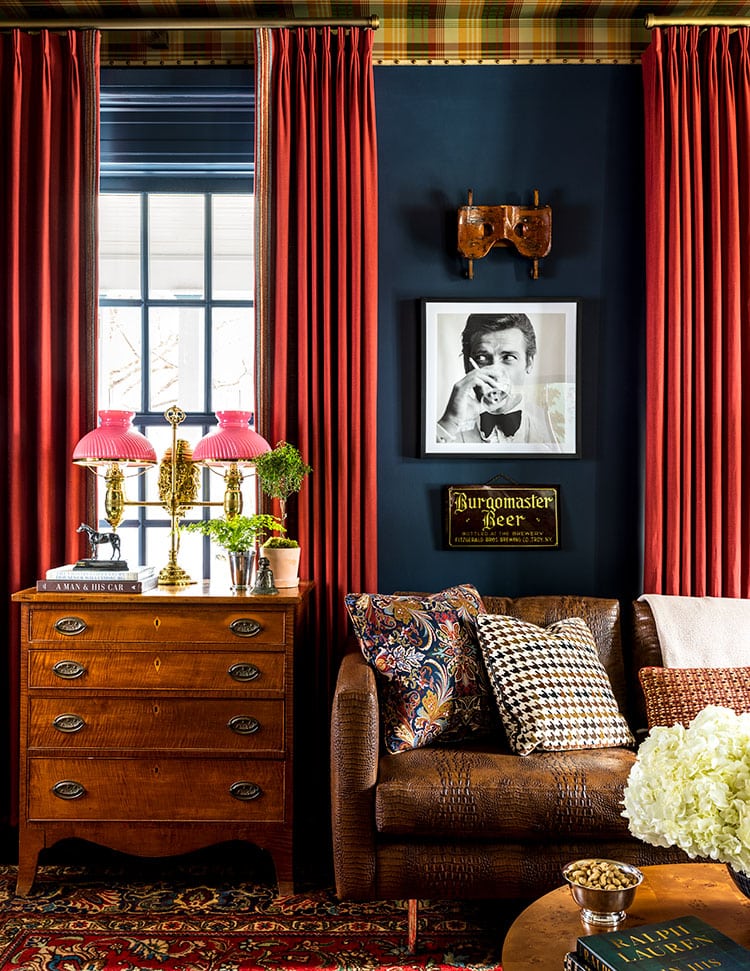
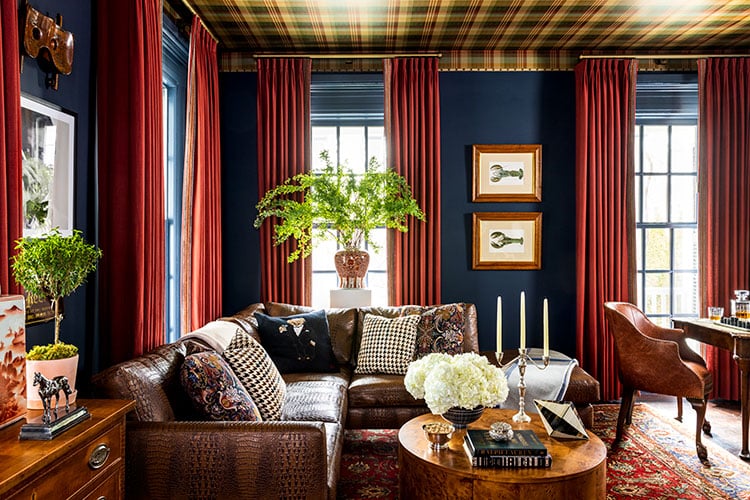
The parlor, anchored in a deep navy blue story, sets the emotional register. Plush seating arrangements invite conversation, while antique case goods lend a sense of permanence and provenance. Red drapery frames the space with a theatrical flourish, softening the intensity of the blue while introducing warmth and intimacy. It is a room designed not only to be seen, but to be experienced—an environment that encourages lingering, storytelling, and the quiet ritual of shared moments. “I wanted this room to feel collected, not decorated,” Jenkins notes. “As though it had evolved over time.”
Art plays a central role in this narrative. A curated collection moves seamlessly between the natural world and cultural iconography: walnut-framed zoological prints of lobsters nod to the home’s coastal context, while an iconic black-and-white photograph of Roger Moore sporting a martini introduces a cinematic edge. Nearby, delicate line drawings of rabbits by artist Hunt Slonem add a layer of whimsy and refinement, their simplicity balancing the richness of the surrounding elements. “Art is the punctuation,” Jenkins says. “It completes the sentence of a room.”
Materiality further deepens the composition. A snake pattern embossed leather sectional introduces texture and a subtle note of intrigue, complemented by a cowhide armchair that adds both contrast and tactile appeal. These are not arbitrary choices, but deliberate juxtapositions—moments where Jenkins allows different design languages to intersect, creating a sense of tension that ultimately resolves into harmony. “Great design lives in contrast,” he adds. “That’s where the magic happens.”
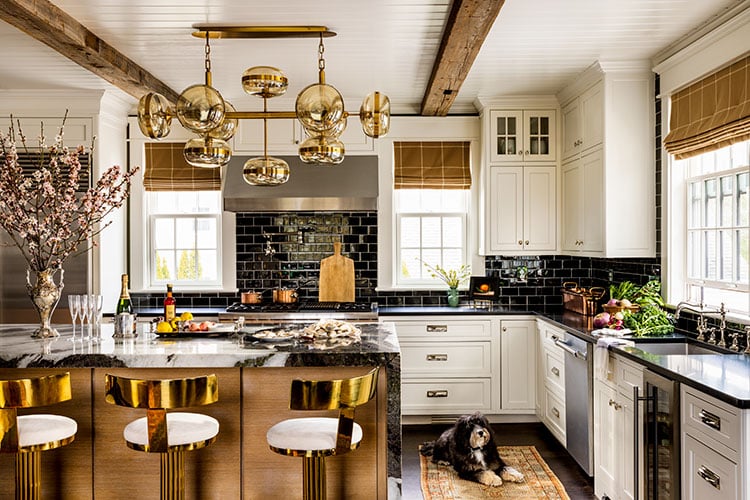
If the parlor establishes the home’s voice, the kitchen expands its vocabulary. Here, a palette of black and ochre bridges centuries of design influence. Glazed subway tile reflects light with a gentle sheen, while classic Shaker cabinetry grounds the space in tradition. Yet the introduction of Art Deco-inspired brass bar stools and a postmodern chandelier—its amber glass globes casting a warm, ambient glow—pushes the room into a more contemporary register. “I love blending eras,” Jenkins says. “It keeps a space from feeling predictable.”
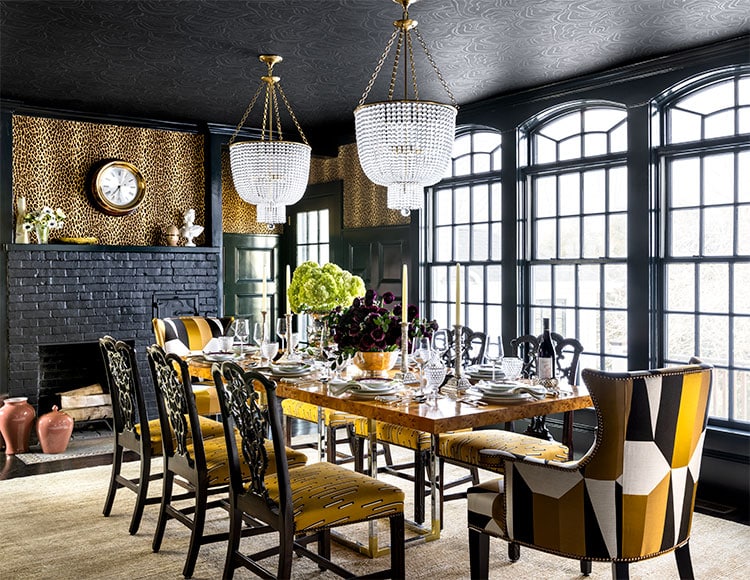
This interplay between eras continues in the dining room, where a dramatic shade of green—so deep it reads almost as black—envelops the walls. The effect is both intimate and commanding, creating a backdrop against which the room’s furnishings can truly sing. Chippendale-style chairs, reimagined in unexpected modern fabrics, surround a steel-based burlwood dining table that feels at once grounded and sculptural. Above the painted brick fireplace, a bold leopard motif introduces a note of irreverence, challenging traditional expectations and reinforcing the idea that elegance need not be predictable. “You have to take risks,” Jenkins says. “That’s how a home becomes memorable.”
Throughout the home, Jenkins demonstrates an acute awareness of scale and proportion, ensuring that each space feels appropriately resolved despite its layered complexity. There is a rhythm to the transitions—a cadence that guides the eye from one moment to the next without abrupt interruption. This is where the musical analogy becomes most apparent. Like a well-composed piece, the design moves fluidly, building intensity in some areas while allowing for quieter, more contemplative passages in others. “It’s about harmony,” he says. “Everything working together.”
Underlying this sense of flow is a deep respect for the home’s architectural heritage. Built in the 1800s, the structure carries with it a narrative of craftsmanship and coastal living that Jenkins is careful to preserve. Rather than impose a wholly contemporary vision, he works in dialogue with the existing framework, allowing historical details to inform modern interventions. “You honor the past,” he says, “but you design for how people live today.”
Equally important is the way the design supports the evolving needs of its inhabitants. With a growing family in mind, Jenkins approaches the project not as a static showpiece, but as a living environment—one that can adapt, accommodate, and endure. Durability, comfort, and functionality are woven seamlessly into the aesthetic fabric, ensuring that the home remains as practical as it is beautiful.
There is, too, an undeniable sense of confidence in the work. Jenkins does not shy away from bold choices; rather, he embraces them, trusting in his ability to bring disparate elements into alignment. This confidence is perhaps what allows the design to feel so cohesive despite its richness. Each decision is made with clarity of purpose, contributing to a unified vision that is both expressive and controlled.
In many ways, the Cohasset project serves as a distilled expression of Jenkins’ broader philosophy. It is a reminder that great design is not about adherence to a single style or period, but about the thoughtful integration of multiple influences. It is about understanding how color, texture, form, and history can come together to create something greater than the sum of its parts.
As the homeowners settle into their reimagined space, the house begins to take on a life of its own. Light shifts across the muraled walls throughout the day, colors deepen and soften with the changing hours, and the carefully composed interiors become the backdrop for everyday moments. It is in these lived experiences that the design truly fulfills its purpose.
Like a symphony brought to life, the home is not static—it evolves, resonates, and endures. And under Jenkins’ careful direction, every note, every detail, and every gesture contributes to a composition that is as enduring as it is extraordinary.
To see more of Jenkin’s work check out his latest book Design Reimagined and his YouTube series also called Design Reimagined, or catch him at Nantucket by Design this summer.
Julie Craven Wagner is the editor of Cape Cod HOME.