The Story Behind The Black Dog Tavern
Cape Cod Dog / DOG Annual 2026 / Food & Dining, History, People & Businesses
Writer: Cape Cod Life Publications
The Story Behind The Black Dog Tavern
Cape Cod Dog / DOG Annual 2026 / Food & Dining, History, People & Businesses
Writer: Cape Cod Life Publications
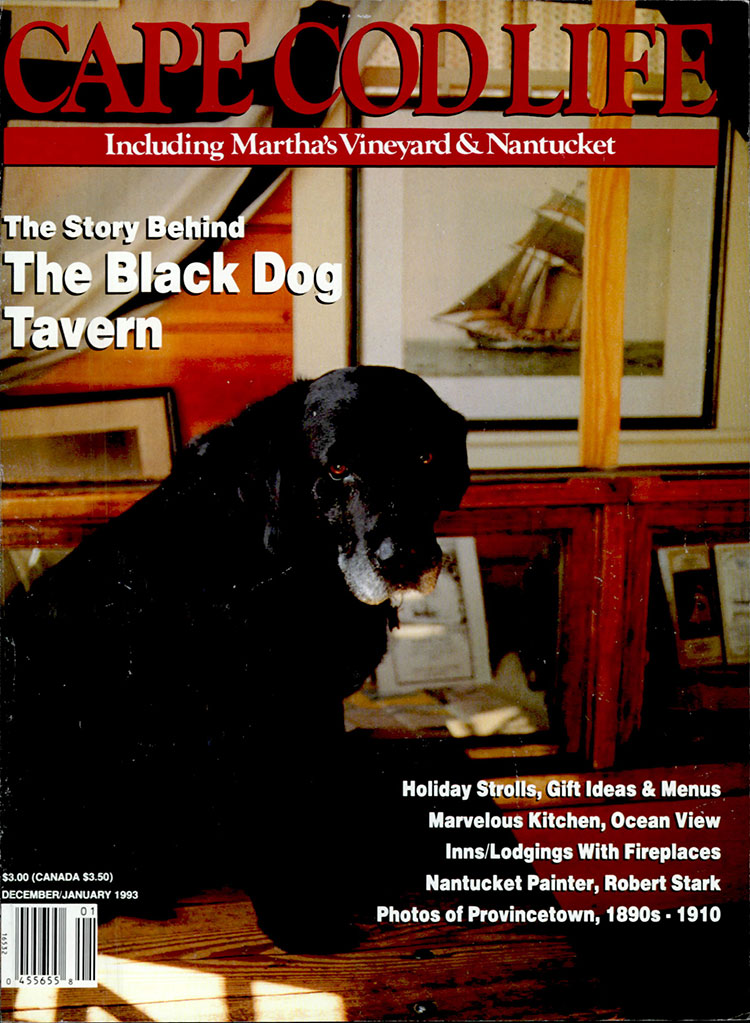
2026 marks the 55th anniversary of The Black Dog Tavern on Martha’s Vineyard—a beloved institution with a story as enduring as its seaside setting. In our December/January 1993 issue of Cape Cod LIFE, we sat down with owner Robert Douglas to reflect on the tavern’s legacy, while photographer Terry Pommett captured a quieter, more personal side of the brand—Douglas’ dog featured on the cover. More than three decades later, that image and the spirit behind it still speaks to the charm, character, and community that define The Black Dog.
By Jacquline Sexton | Photography by Terry Pommett
The Black Dog Christmas catalogue rolled triumphantly off the presses last October, bigger than ever and packed with new offerings for eager collectors of Black Dog artifacts. The 30-page, six-color catalogue is indisputable testimony to the popularity and staying power of the black dog image, first offered a scant five years ago through a single, folded white sheet of paper featuring half a dozen items including the now famous Black Dog t-shirt.
Photography by Terry Pommett
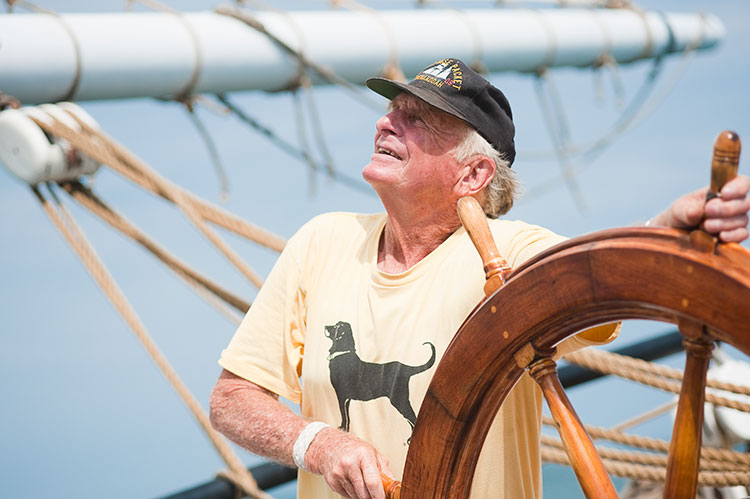
Who’s to say why the profile of a winsome black dog with upswept tail and white feet should so touch people all over the world, most of whom have never been to Martha’s Vineyard, let alone to The Black Dog Tavern in Vineyard Haven where it all started? “There are people in Africa wearing that t-shirt,” says Black Dog owner Robert Douglas incredulously.
“We thought of it as just a nice memento for people who had been here. I never thought my old Black Dog would become internationally famous. Maybe people like the simple, clean image.” Robert’s wife, Charlene, designed the logo, which now appears on baseball caps, tote bags, beach towels, beach apparel, frisbees, coffee mugs, and, with this winter’s twelfth edition of the catalogue, on dinner plates and chowder bowls, on boxer shorts and night shirts, and on a magnificent hand-knitted wool sweater. Perhaps significantly, Black Dog sweats and tees are just as popular at home on the Vineyard where no one needs a memento.
The image has even become the subject of a law suit. When a local entrepreneur started selling what he called a parody of The Black Dog t-shirts, picturing an upside down “dead dog” or a hog The Black Dog took action. “We have to protect the copyright,” says Douglas.
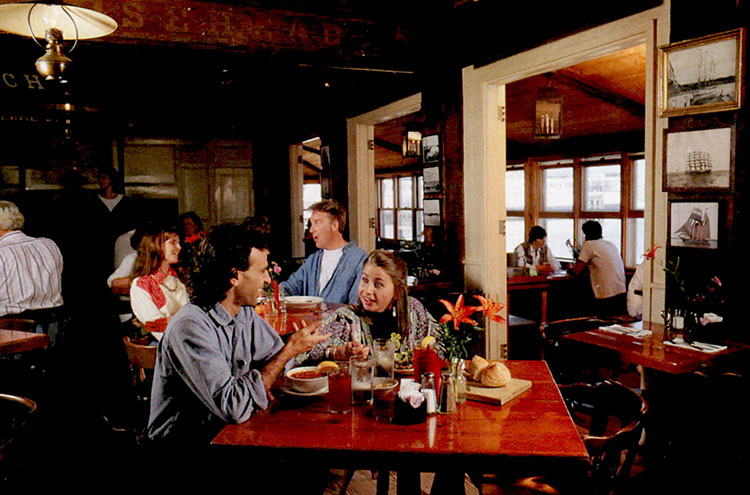
It should come as no surprise, really, that the t-shirt caught on. Black Dog enterprises have flourished since the tavern opened for business on New Year’s Eve in 1971. That it may be the only tavern in history set in a dry town where the likelihood of obtaining a liquor license is nil hasn’t even been an issue. Locals and Island visitors alike flock year around to its dimly lit interior where marine artifacts hang from the rafters. The ambience is informal, friendly, and noisy. During the ever-lengthen-ing summer season the main room and adjoining glass-enclosed porch, as well as the small waiting room at the entrance, are all filled.
“Everyone told me we couldn’t make it work without a liquor license. ‘It won’t go without booze,’ they said. Well, we proved them wrong,” Douglas says with a grin of satisfaction.
The idea for The Black Dog Tavern came about naturally enough when Captain Douglas first sailed his topsail schooner, Shenandoah, into Vineyard Haven Harbor, approving of all he surveyed, save one egregious lack: ‘There wasn’t a full-service restaurant in town,” he says. In his peregrinations around town, he kept coming back to a “little, falling-down boat house,” right on the water. “Good spot for a restaurant,” he thought. This was to be the site of the future Black Dog Tavern.
Robert Douglas, tall, rugged, and displaying the mariner’s formal courtesy, took time off from working on his boat this sparkling October morning to talk about his old companion, Black Dog and the origins of the tavern.
Asked why he named the restaurant after his dog he shrugs and says “It seemed like a good idea.” A local artisan, Charlie Weade, carved the figure of Black Dog for the sign outside the restaurant, and like any artist’s model, Black Dog had to pose. Douglas says, “Charlie used to come pick her up in his truck for the sittings.” Black Dog was her name, and she was a Vineyard Whitefoot. “She was part brindle boxer and part golden retriever. So many people kept asking what breed she was, we made one up.” And thus was born the Vineyard Whitefoot, none of whom, sadly, survive today. Douglas shows emotion when he says Black Dog died in 1983 at the age of fifteen. “She was the best dog I ever had.”
Photography by Terry Pommett
Talking of the restaurant’s beginnings, he says, “I had in mind a sort of chowder house on the waterfront, a tavern with a roaring fire, old-time, old-fashioned, warm, with a simple, basic menu, chowder and sandwiches. A place that could be the heart of the town.” And that, with considerable amplification of the original menu, is what The Black Dog Tavern is today.
Douglas hired Alan Miller, a restorer and builder known locally for solid building and as something of a specialist in fireplace design. “We got the heavy pine beams from a demolition company in Boston,” Douglas says. The open porch, smack on the water, was later enclosed and furnished with tables. So far, hurricanes have left it alone.
“The high tide came up and touched it during last year’s October northeaster, but there was no flooding and no damage.”
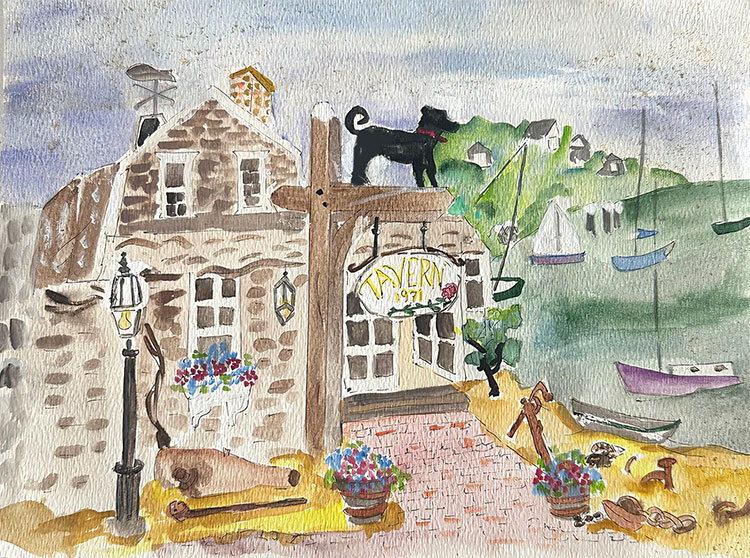
“I wanted to put some history in the layout, try to recreate the atmosphere of the town’s past, the real Vineyard Haven. It seems to me that most of the interesting things that happened here happened in the past.” The building is traditional grey shingle with white trim and a cedar shingle roof. The pathway outside is paved in brick and lit at night with Beacon Hill-style lamps. An enormous aged anchor embedded in the ground near the entrance adds dramatic emphasis. Douglas likes to think he has set an example for some of the other Vineyard Haven properties and influenced their owners to look back to the early days of the town.
The aura of the tavern on the waterfront with the Shenandoah resting at anchor, the whole bathed in the hazy blue light of a full moon, has been given its place in history through an elegant painting by renowned maritime artist John Stobart.
Douglas gives Joseph Hall, Black Dog’s manager for the last 12 years, a free hand. “He’s the one who really made it work,” he says. Douglas rhapsodizes about the breakfast menu which, he says, shows “remarkable ingenuity.” Belgian waffles; strawberry and chocolate chip pancakes; scrambled eggs in a tortilla with salsa and cheese; and omelettes with smoked bluefish, with shrimp and sausage, or with smoked salmon, scallions, and cream cheese are among the offerings. Anyone who doesn’t feel that daring in the morning can have a plain poached egg. Breakfast, lunch, and dinner menus change daily.
There are no primadonnas and no executive suites among The Black Dog managing team or the more than 100 employees. Hall and marketing manager Elaine Sullivan share a cluttered space about the size of a largish sea chest on a floor divided with similar cubicles located at the back of the building and accessible only by an outside stairway.
“Welcome to chaos,” says Sullivan. But there is order in the chaos. The working arrangements, like the ones in the restaurant, are informal, friendly, and noisy. “Nobody gets real territorial around here,” says Sullivan, a lively young woman who came from California in 1987 and is clearly in her element juggling the many facets of her job.
“People here are not regimented,” she says. “They have the freedom to be creative. In the restaurant everything is done the better way—with the best and freshest there is. We know where it comes from. We make meals like meals you would serve to your family.” There are no microwaves—in fact, as a matter of policy, the kitchen crew is anti-microwave. And there are no shortcuts. The cooks use whole eggs, real butter, the best olive oil, and real maple syrup. Most of the vegetables are grown on the Island and delivered daily. Fishermen show up at the kitchen door with their day’s catch. “It’s a family sort of place,” Sullivan says. “Bob Douglas comes in now and then, just to hang out, have some chowder. So does his crew from the Shenandoah.”
Charlie Esposito, a wiry New Yorker with curly black hair, is in charge of the floor, the waiters, and the serving bar. He has been at The Black Dog for 17 years. “It’s a great place,” he says. “It’s like a community center; all your friends who work together or work somewhere else all together here.” And he thrives, he says, on the free-wheeling Black Dog style. Jack Livingston, the head chef, a 15-year Black Dog cap. He inspects page proofs of the catalogue, now in its final days of preparation.
“The catalogue,” explains Sullivan, “is sent only to people who ask for it. There’s too much work and money involved for people to throw them away.
This one will go to 40,000 people. We don’t buy mailing lists.”
Printed on recycled paper, the catalogue is, first of all, a work of art. No glitz, no gimmicks, and no 800-number. Inside, it’s spoofy, nostalgic, serious, and persuasive, all at the same time. It is replete with the Vineyard, the sea, and, of course, the ubiquitous black dog in her hundreds of incarnations. Mixed in with the products for sale are salty “sillinesses,” some sumptuous Black Dog recipes, and, an unlikely catalogue feature, a plea for funds. “We try to put something altruistic in the catalogues.” The latest one explains the need for a new bus by a local summer camp for the disabled. Priority is given when possible, to local businesses or craftsmen, as in the case of the wool fishermens’ vests, designed by a Vineyard couturier, where the black dog image has gone underground and shows up only in a discreet label.
Response to the catalogues comes from all over. “I’ve gotten emergency faxes from Hollywood ordering 20 or so t-shirts that they need the next day,” says Sullivan. “And last summer a Time-Warner CEO, anchored in the harbor, called and ordered several cases of sweatshirts, t-shirts, and some other things. His butler came to pick them up.”
If the past couple of decades are any indication, The Black Dog is likely to turn up somewhere, some time, in yet another guise. In fact, there is talk of starting a brewery and opening a brew pub and a small restaurant—a real tavern this time—in the part of the Martha’s Vineyard airport that lies in Edgartown, which is not dry. “But,” Sullivan warns, “this is in talking stages only.”
This story was first seen in Cape Cod LIFE December/January 1993. It has been edited by Cape Cod Life for republication. Learn more about Captain Bob Douglas at capecodlife.com/bob-douglas-the-black-dog/.