A Century on the Shore
A Century on the Shore
Cape Cod Home / HOME Annual 2026 / Home, Garden & Design
Writer: Julie Craven Wagner
With a designer-member guiding its BRICC Award-winning transformation, the Beach Club enters its second century—structurally fortified, artfully refined, and still unmistakably itself.
When a building has stood for nearly 100 years on one of the Cape’s most storied stretches of shoreline, you don’t simply renovate it. You approach it with restraint. With reverence. With an understanding that what you are touching is not just timber and stone, but memory.
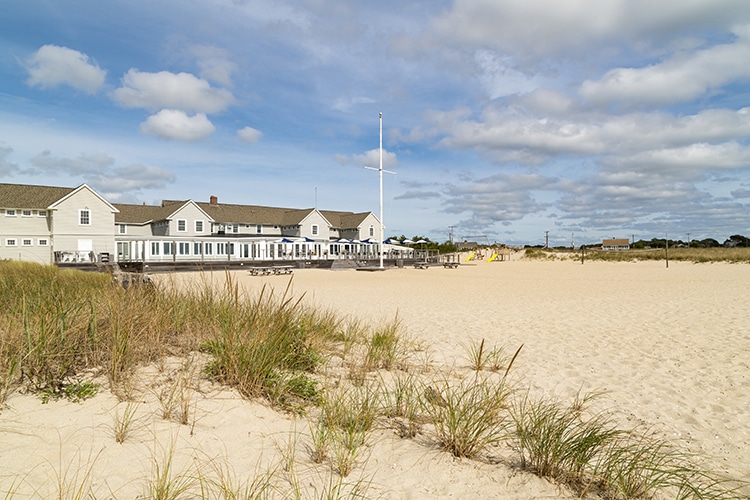
Since 1927, The Beach Club in Centerville has served as a seasonal anchor for generations of families along Nantucket Sound. Weddings, anniversaries, bridge games, sandy lunches, children running in from the surf—the rhythms of summer have been set against its beachfront façade for almost a century. So, when the Club embarked on a multi-year capital improvement campaign beginning in 2021, the stakes extended far beyond aesthetics. Under the careful guidance of interior designer Debra Classen, of Osterville-based William Conrad & Co. Interiors, and Ben LaMora of Lineal Architects + Builders, the Club’s future began to take shape.
The effort began below the floorboards.
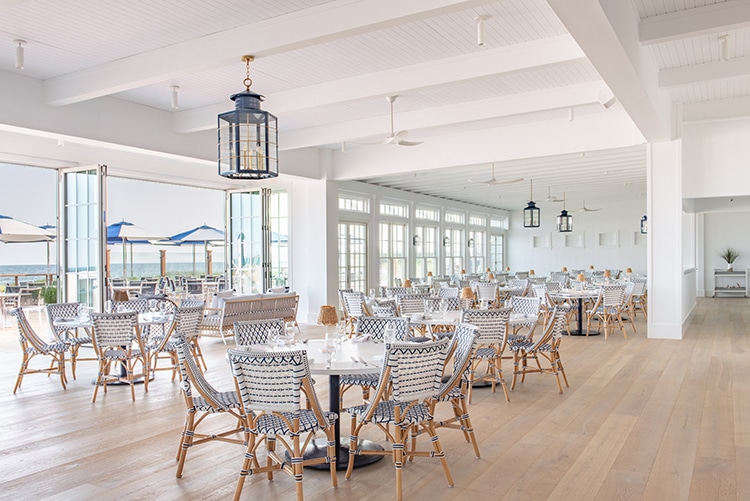
What started as foundational reinforcement evolved into a comprehensive reimagining of the clubhouse—LaMora commenced with structural upgrades; Classen focused on interior refinement; the pair reworked gathering spaces, modernized locker rooms, renovated a kitchen, and most recently, transformed the form and function of the Club with a redesign of the dining room. The current phase, now nearing completion, includes a new foundation system, raised ceiling heights to nearly twelve feet, architectural acoustics integrated between exposed rafters, upgraded lighting, and expanded openings that recalibrate the relationship between indoors and out.
The result earned a 2025 BRICC Award, but for the membership, the real measure of success has been something less tangible: walking into a familiar place and feeling both astonished, and at home.
A STEWARD FROM WITHIN
Debra Classen was not an outside consultant brought in to reinterpret the Club. She has been a member since 1987. For nearly four decades, she has served on committees, volunteered her time, and participated in incremental improvements long before this comprehensive campaign began. That dual identity—designer and member—became the project’s compass.
“There’s a lot of emotion involved,” she says. “Walking into The Beach Club is a very personal experience for our members. It’s often passed down through generations. Our job was to protect that.”
Designing for a private club is unlike residential or commercial work. In a home, one family defines the vision. In a club, there are hundreds of voices—legacy members resistant to change and younger families seeking a more contemporary experience. Every decision must strike a balance that feels inevitable rather than imposed.
Deb describes her client succinctly: “Three hundred and fifty members.” And yet, the renovation never feels committee-driven. It feels intentional. Reinforcing that commitment was the overwhelming response to the capital campaign which truly served as a barometer of the membership’s investment in this worthy project.
FORTIFYING FOR THE NEXT HUNDRED YEARS
Before finishes were selected or furniture specified, the building itself required serious attention. Structural reinforcement was critical, particularly in the dining room and bar areas, where aging supports needed modern intervention. Helical piles were installed to secure foundations in challenging coastal conditions. Mechanical systems were upgraded and discreetly integrated so as not to disrupt historic character. Accessibility improvements were carefully layered in. The aim was not to make the building look new. It was to make it endure.
The dining room, once an open-air veranda—or “piazza”—originally defined by a pergola—which was later filled in over time with three successive layers of dropped ceiling—presented both opportunity and risk. Today, reimagining it, while providing full enclosure of that space would allow for expanded seasonal use and better functionality, but it also meant altering one of the Club’s most beloved visual memories.
The solution was architectural sensitivity.
During demolition LaMora discovered the charming detail on the original rafters and Classen impressed upon LaMora to preserve the feel of the original carved pergola tails. Those details were then replicated and reintroduced along the roofline of the newly enclosed dining room—a subtle homage to 1927 that anchors the contemporary intervention in authentic lineage. It is not a decorative afterthought; it is a lineage made visible. And that exchange of ideas and vision exemplifies the truly collaborative process Classen and LaMora successfully forged over the years this project spanned.
HEIGHT, LIGHT, AND AIR
Perhaps the most transformative spatial move was vertical. By increasing the interior ceiling height from approximately eight feet to nearly twelve, the dining room shifted from enclosed to expansive. Exposed rafters now span overhead, creating volume and rhythm. Between them, architectural acoustic treatments were integrated to soften sound—an invisible improvement that dramatically enhances comfort during crowded summer evenings.
Light became a defining material.
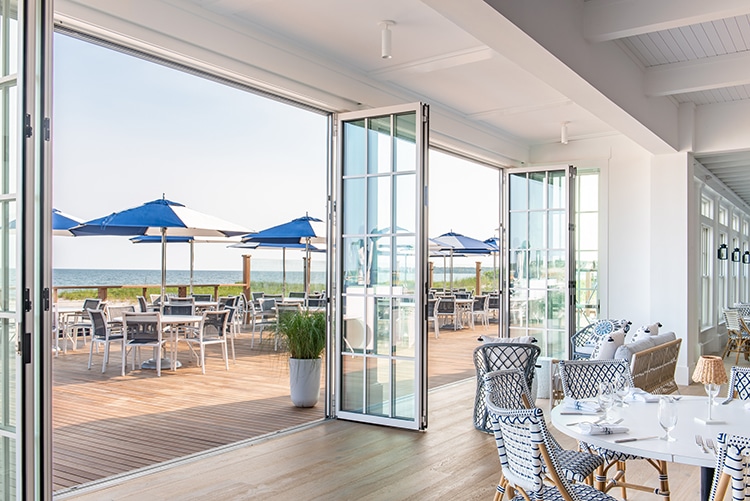
Expansive NanaWall systems replace former openings, allowing entire walls to fold away when weather permits, which the design team, the board and the members all emphasize the positive and dramatic effect that choice allowed. When open, the dining room once again reads like the original piazza—an extension of the deck and beach beyond, and truly blurs the lines between the physical structure of the Club and the natural coastline. When closed, the room remains luminous and weather-tight, offering year-round sophistication without sacrificing coastal informality.
Members noticed something unexpected: even on perfect beach days, they now choose to dine inside. The combination of height, light, refined finishes, and uninterrupted views altered behavior. The interior no longer feels like a fallback during rain; it feels like part of the shoreline experience.
REIMAGINING THE “BULLNOSE”
One of the renovation’s quiet masterstrokes involved rethinking a curved transition zone between deck and dining room—known internally as the “Bullnose.” Rather than preserve its semi-circular footprint out of habit, LaMora squared off the opening to better accommodate the expansive door systems. The architectural shift created something more valuable than geometry: flexibility.
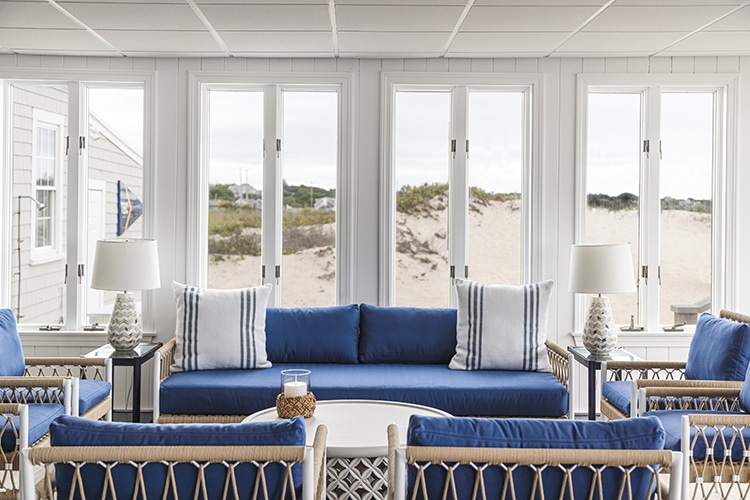
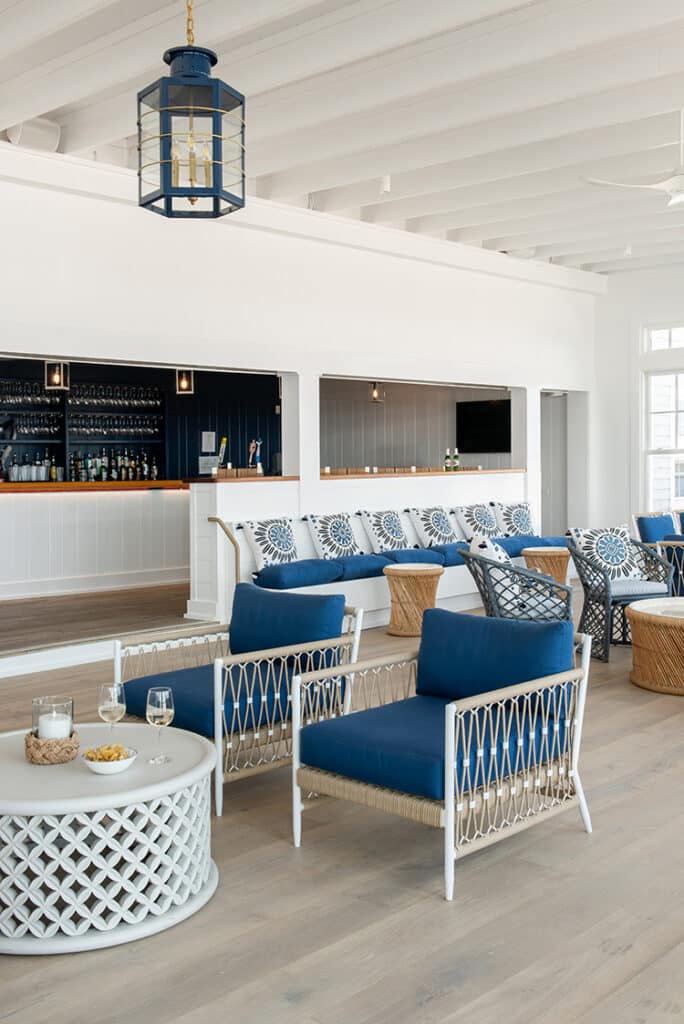
Where traditional dining tables once dominated, lounge seating now occupies the threshold—woven rope settees and chairs paired with low garden stools. It has become the most coveted perch in the Club. Members gather there for morning coffee, afternoon respite, and sunset wine.
It is a study in subtle recalibration. Nothing feels radical. Yet everything feels different.
MATERIALS THAT RESPECT HISTORY
Material selection demanded careful balance between durability and authenticity. Commercial-grade alternatives were considered—and rejected. In a building approaching its centennial, luxury vinyl tile would have read as expedient. Instead, Classen and LaMora conducted extensive research before specifying a pre-engineered white oak floor from Sawyer Mason. The chosen plank width and tone complement the building’s character while offering resilience against sand, humidity, high heels, and heavy event traffic. It performs under pressure and reads as timeless.
Outside, the deck is clad in Ipe—dense, weather-resistant, and well suited to coastal exposure—paired with cable rail systems that preserve uninterrupted views of Nantucket Sound.
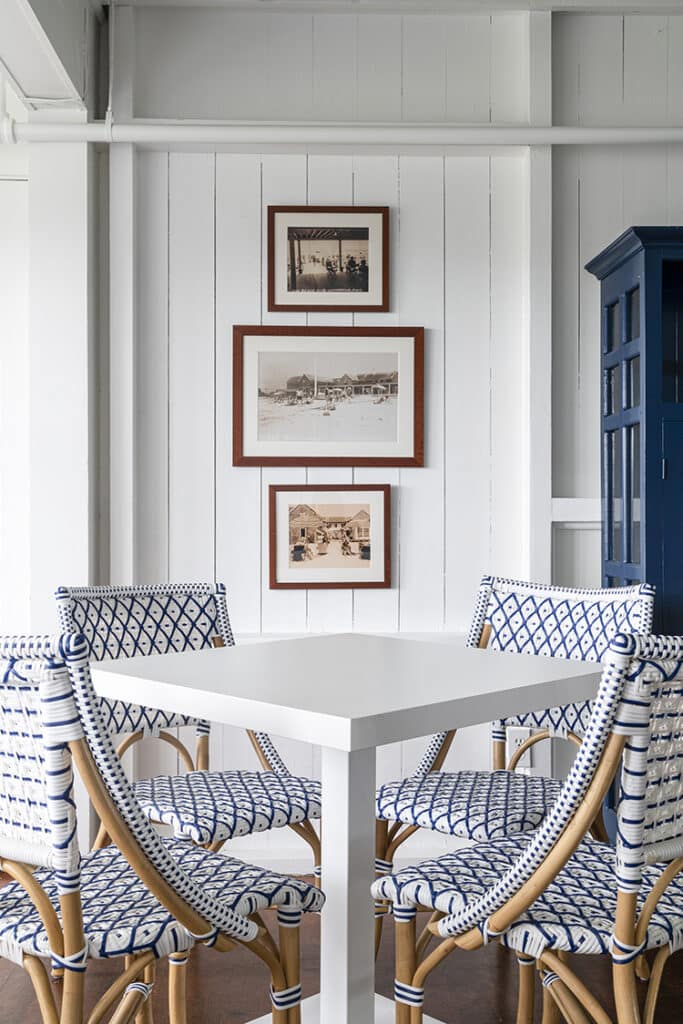
Furniture selections were equally intentional. Dining chairs—customized to be stackable and structurally reinforced—feature blue-and-white woven backs that subtly elevate the room. They are not the predictable French bistro form. They are familiar, yet refined.
Half of the seating comes from Serena & Lily, reupholstered in performance fabrics chosen for both aesthetic and endurance. Rope-woven details echo nautical textures without leaning into cliché. Cushions were specified in materials capable of withstanding weddings, spills, salt air, and children fresh from the beach. And everything was tested against real use and registered a win as critical as any regatta standings boasting upon the historic walls.
LIGHTING AS NARRATIVE
With expanded ceiling heights came the need for thoughtful illumination. Architectural lighting provides necessary brightness, but decorative fixtures provide atmosphere. Nauset Lantern was selected for key pendants and sconces—locally crafted pieces that nod to coastal New England heritage. A custom-sized central pendant anchors the dining room, scaled precisely to the new volume. Carriage-style sconces punctuate window walls, adding warmth and intimacy at dusk.
In the evening, the space glows rather than glares. The lighting does not compete with the view. It enhances it.
HONORING THE YELLOW TRAY
Perhaps the most emotionally delicate change in the renovation was the elimination of the food line, dubbed the “Servery”—a ritual where members once queued with iconic yellow trays, chatting while sandwiches were assembled before them.
The inefficiencies were clear, yet the nostalgia was powerful.
Rather than erase the tradition, Classen reframed it. A curated installation of preserved yellow trays now hangs in an artful grid near the Servery, set against a saturated blue wall aptly painted a hue called “Salty Dog.” It is decorative, symbolic, and instantly recognizable.
The trays remain, and the process evolved. Table service has replaced the line, and though some wistfulness lingers, the membership has embraced the change. It allows for smoother flow, expanded events, and a more refined dining experience—while the tray installation ensures memory remains visible.
CURATED RESTRAINT
Art throughout the Club reflects a shift toward cohesive curation. In years past, rotating committees and member contributions created an eclectic aesthetic. The new direction is more intentional.
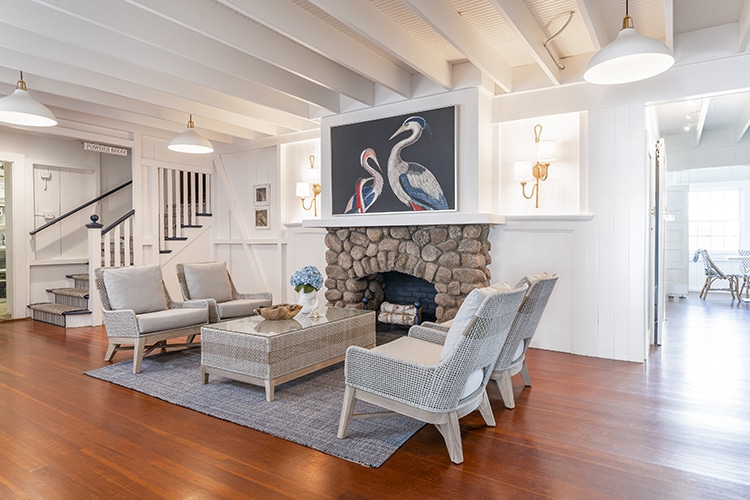
Working with Wendover Art Group, Classen selected customizable works that complement the interiors without overwhelming them. A triptych suggestive of schooling fish hangs where the food line once stood—a playful nod to collective ritual. In the Club Room, a dramatic piece featuring Blue Herons commands attention above the original stone fireplace, grounding the room’s darker, more historic tone. The art punctuates the architecture rather than competing with it.
CULTURE SHIFT
The renovation has done more than improve finishes; it has subtly recalibrated how members engage with the Club. Bridge attendance has increased. Mahjong groups have multiplied. Showers, teas, and weddings are booking years in advance. The season has extended further into September and beyond. Members linger longer. They arrive slightly more polished, responding instinctively to the elevated environment.
The Club still tolerates sandy feet and damp cover-ups. It always will. But it now carries an undercurrent of international polish—a whisper of Portofino or San Tropez layered beneath its unmistakable Cape Cod identity.
It remains a beach club, yet it feels like a world-class destination.
INTO THE SECOND CENTURY
As The Beach Club approaches its centennial, additional initiatives are underway: curated heritage photo walls, digitized historical archives, and recorded oral histories capturing members’ memories. The renovation is not the end of a story; it is the opening chapter of the next hundred years.
For Classen, the responsibility has never felt casual. “I’m honored to be given this opportunity,” she says. “But it’s also a responsibility. I approach it with integrity.” That integrity is visible in every preserved latch, every replicated pergola tail, every carefully scaled pendant.
The Beach Club today is brighter, stronger, and more adaptable than it was five years ago. Yet it remains fundamentally unchanged in spirit. It still anchors summer. It still frames memory.
Only now, it stands fortified—ready to hold another century of it.
Julie Craven Wagner is the editor of Cape Cod HOME.