Holding On, Letting Go
Cape Cod Home / Early Summer 2026 / Home, Garden & Design
Writer: Julie Craven Wagner / Photographer: Dan Cutrona
Holding On, Letting Go
Cape Cod Home / Early Summer 2026 / Home, Garden & Design
Writer: Julie Craven Wagner / Photographer: Dan Cutrona
On Gunning Point in Falmouth, a century-old home is thoughtfully reimagined by Hutker Architects and M. Duffany Builders—balancing preservation, innovation, and sweeping views of Buzzards Bay.
Perched high above the water on Gunning Point, the house reveals itself slowly. The approach is quiet, almost understated, the structure emerging not as a grand statement but as something settled—rooted into the land with the quiet confidence of age. Beyond it, the land falls away toward Buzzards Bay, where the horizon stretches uninterrupted, and the rhythm of tide and wind defines the passage of time.
It is a place where change happens gradually, often imperceptibly. Light shifts. Water moves. Grasses bend and return. The house, for more than a century, has stood within that continuum—absorbing time, adapting to need, and carrying forward the imprint of those who have lived within its walls.
By the time its current owners arrived, the home had become something of an architectural record—each decade leaving behind its own interpretation of what the house should be. Some interventions honored the original structure; others, though well-intentioned, obscured it.
“There were moments where you could feel the authenticity of the house,” the homeowner recalls. “And then there were moments where it felt like you were moving through someone else’s idea of it.”
That distinction became the foundation of the project. The goal was not to impose a new identity, but to rediscover the existing one—to understand what the house had been, and to carefully guide it back toward that clarity while making it functional for modern life.
Working with Hutker Architects and M. Duffany Builders, with Dennis Belanger leading the construction effort, the process became one of thoughtful editing. Every element was examined, questioned, and ultimately either preserved, reworked, or removed.
“In a house like this, you’re not just building,” Belanger explains. “You’re uncovering. You’re trying to figure out what’s worth keeping—and sometimes that means making some pretty big changes.”
The most consequential of those changes began at the center of the home.
A massive chimney, once essential to the house’s function, had become a defining obstacle. Structurally significant and deeply embedded, it divided the home into a series of disconnected spaces, limiting both circulation and natural light.
“It controlled everything,” Belanger says. “You couldn’t really fix the flow of the house without dealing with it.”
Its removal was not a simple act of demolition, but a carefully orchestrated structural undertaking. Loads had to be redistributed. Framing had to be reinforced. The integrity of the house had to be preserved even as one of its core elements was taken away.
Once removed, however, the effect was immediate—and profound.
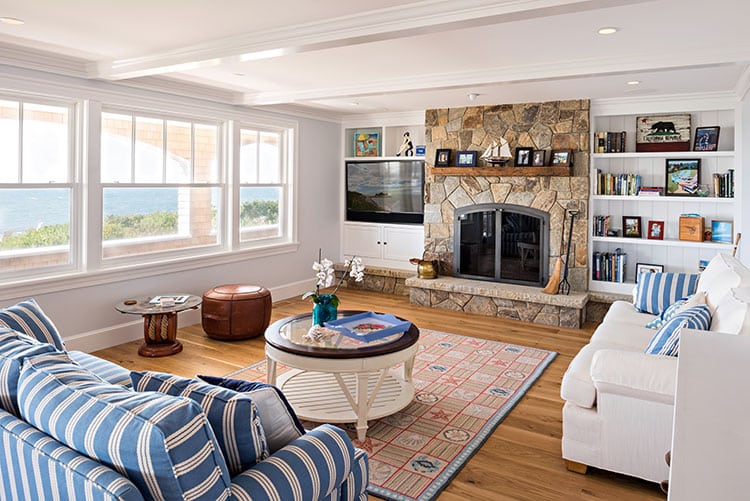
Light traveled differently. Sightlines extended. Rooms that had once felt isolated began to relate to one another in a way that felt natural, even inevitable. The house, in a sense, regained its internal coherence.
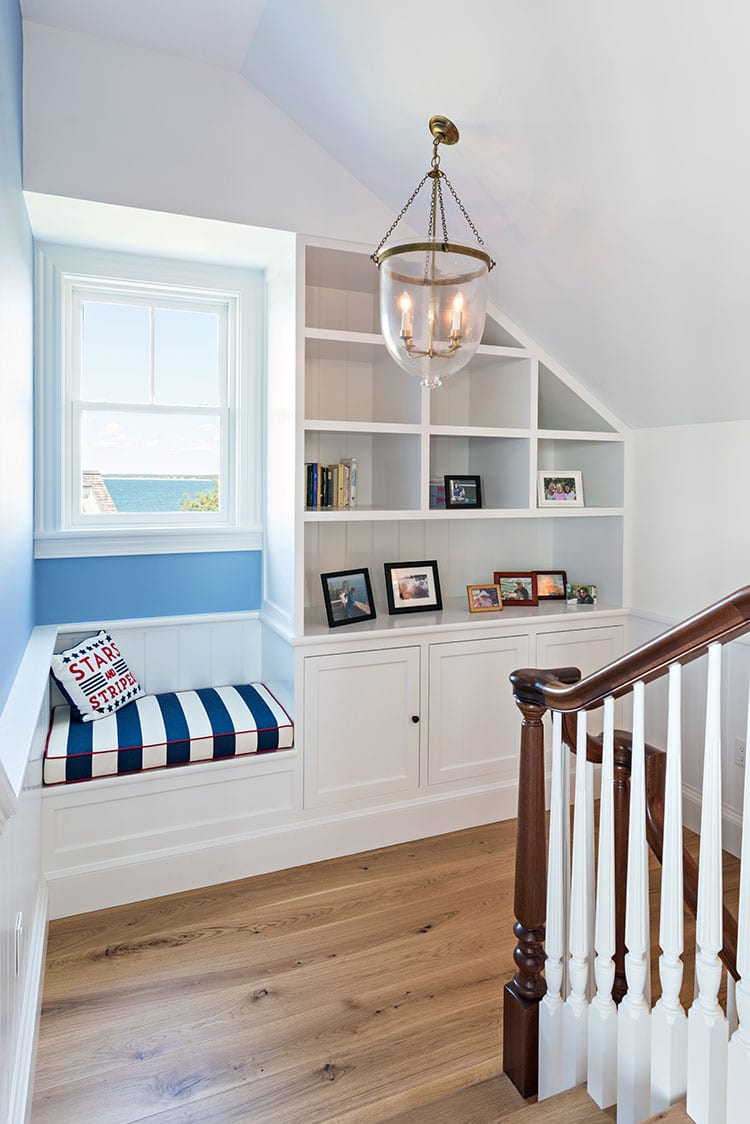
That intervention also allowed for the rethinking of the central stair, another element that had evolved awkwardly over time. Repositioned and redefined, it now serves as a clear and intuitive connector between floors, reinforcing the architectural logic that had long been obscured.
“These are the kinds of moves that you don’t always see right away,” Belanger notes. “But you feel them. They change how you move through the house.”
Elsewhere, the work required a different kind of sensitivity—one rooted not in removal, but in preservation.
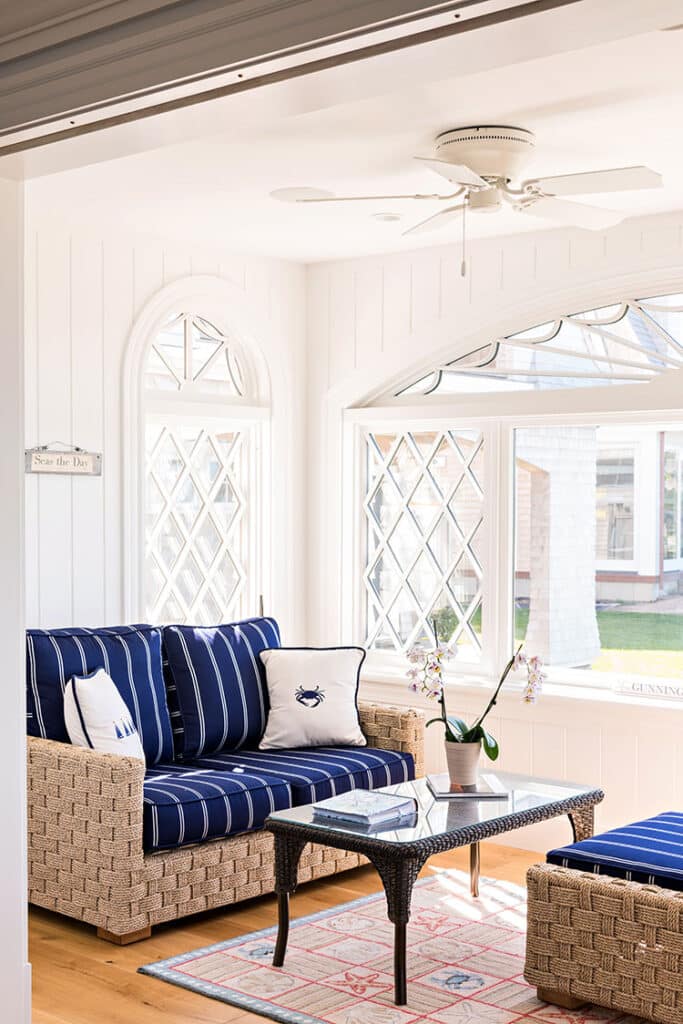
Throughout the home, original details were carefully evaluated for their potential to be retained. Among the most significant of these were the decorative antique windows—elements that spoke directly to the craftsmanship of the original structure.
Many had been removed or sidelined in previous renovations. Rather than discarding them, the team undertook the painstaking process of restoring and repurposing them, reintroducing them into the home in ways that honored their history while giving them new life.
“They’re not perfect,” the homeowner notes. “But that’s what makes them special. You can see the age in them.”
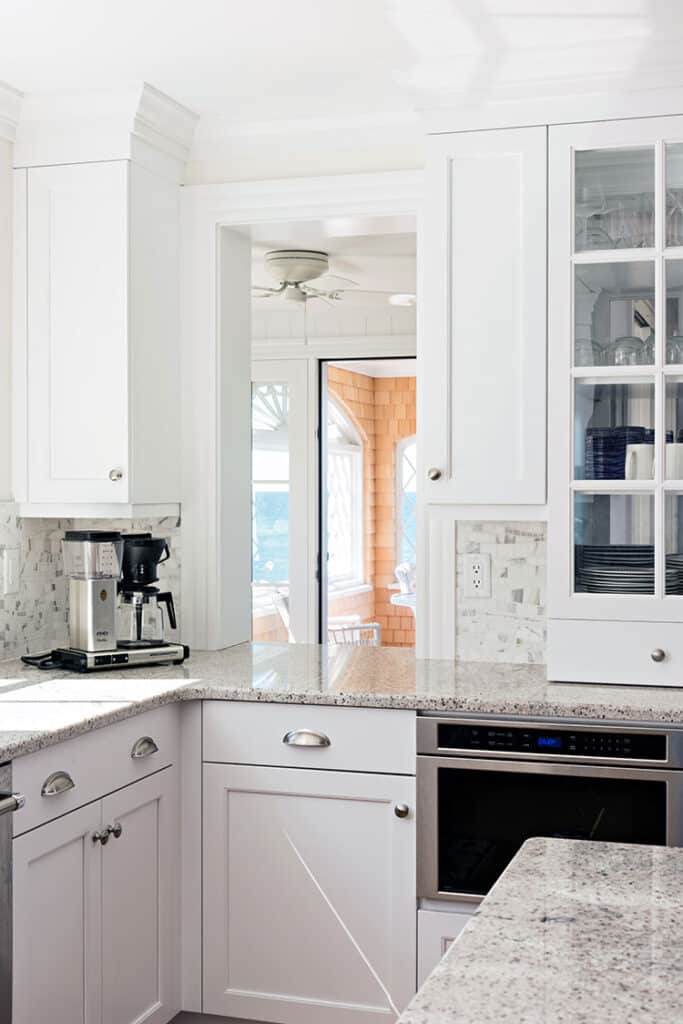
At the same time, new windows were introduced with equal care. The selection of Andersen Eagle windows was driven by a desire to match the scale, proportion, and visual language of the originals as closely as possible. The result is a seamless dialogue between old and new—an updated building envelope that performs to modern standards without disrupting the character of the home.
Nowhere was the balance between constraint and creativity more evident than in the lower level.
A previous renovation had lifted the house to create a full basement, replacing the original stone foundation. While this added usable space, it also introduced a limitation: ceiling heights that fell short of accommodating the homeowners’ vision for a home theater.
Rather than abandoning the idea, Belanger approached it as a challenge.
“The height just wasn’t there,” he says. “So we had to find it.”
The solution required both ingenuity and precision. By excavating down within the existing footprint and creating a descending seating arrangement, the team was able to effectively increase the usable height of the space without altering the structure above. The result is a theater that not only functions as intended, but enhances the experience through its tiered design.
“It’s about working within the limits of the house,” Belanger explains. “And sometimes those limits push you toward something better.”
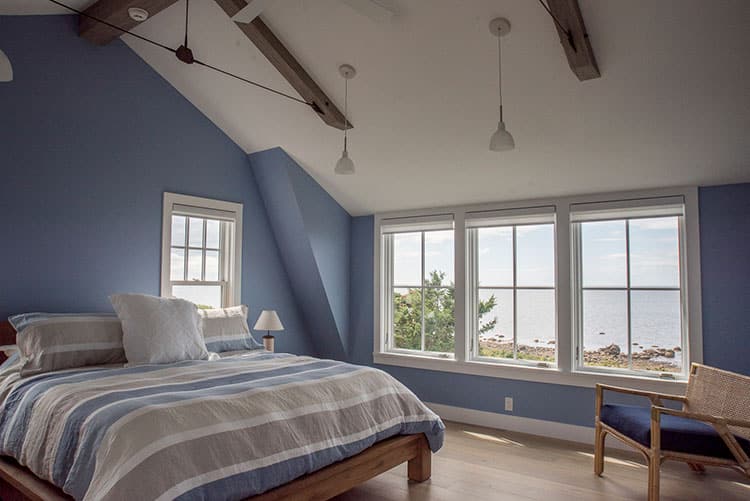
Upstairs, attention turned to the third floor, where a previously added balcony and viewing area had introduced the idea of engaging with the view, but lacked the refinement to fully realize it. Reimagined with greater clarity and intention, the space now frames the landscape in a way that feels both natural and inevitable.
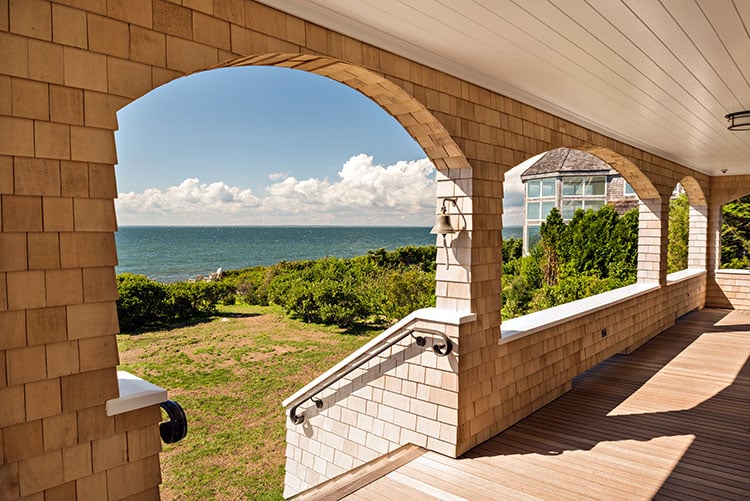
From this vantage point, the relationship between house and setting becomes unmistakable. The land slopes gently toward the water. Marsh grasses shift in the foreground. Beyond, Buzzards Bay stretches outward, uninterrupted.
It is a view that requires no embellishment—only the restraint to let it speak.
That restraint informed every aspect of the project, guiding decisions both large and small.
Even the addition of a guest house—constructed on an adjacent lot acquired during the renovation—was approached with a careful sense of balance.
Also designed by Hutker Architects, the guest house offers a deliberate contrast to the historic main residence. Where the original home leans into its past, the new structure embraces a more contemporary expression.
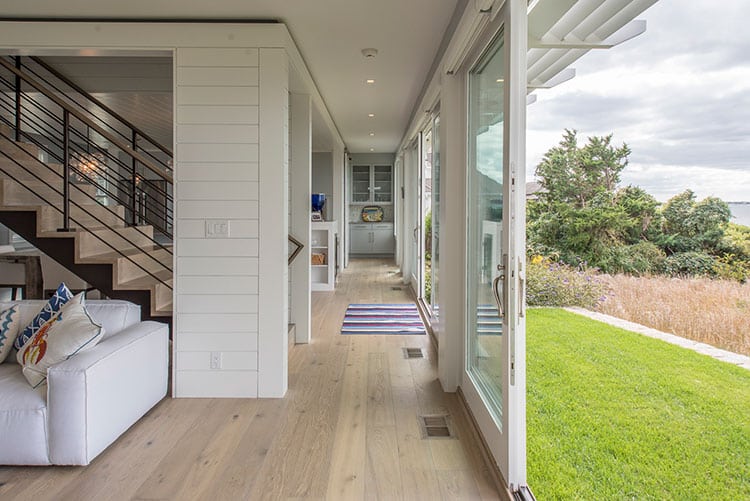
Inside, nickel-gap paneling introduces a crisp, linear texture that defines the walls, while an open, floating staircase creates a sense of lightness and movement. A striking quartz wall, anchored by a set-in gas fireplace, separates the living and dining areas while maintaining visual continuity between them.
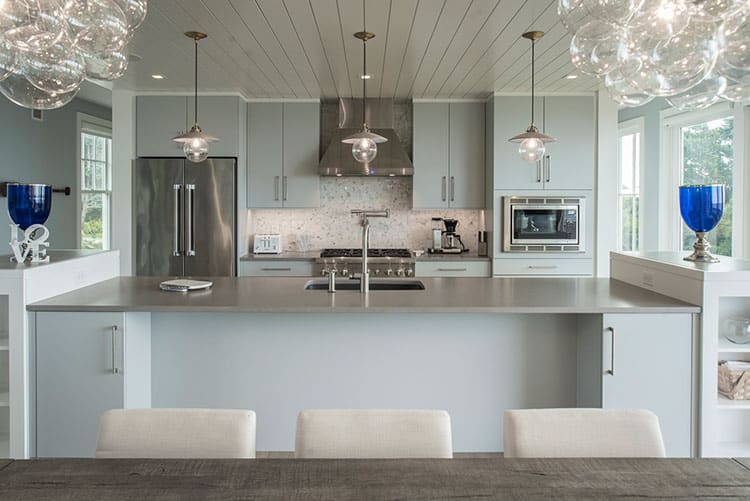
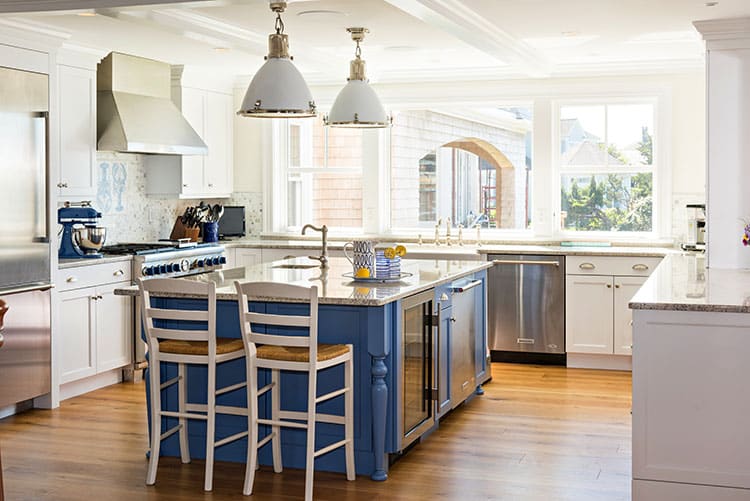
The kitchen, open and sophisticated, becomes a natural gathering point. Above the island, a pair of sculptural bubble glass chandeliers hover like suspended droplets, catching and diffusing light in a way that echoes the reflections of the bay beyond.
Here, the experience of the home shifts subtly. The language is different—cleaner, more modern—but the connection to place remains constant. Views continue to command attention. Light continues to shape the experience of space.
“The guest house gave us the opportunity to do something a little more contemporary,” Belanger says. “But it still had to feel connected to everything else.”
That connection is evident not only in the dialogue between the two structures, but in the way they function together. The guest house allows for a level of flexibility that supports extended family and visitors, while preserving the intimacy of the main home.
As the project neared completion, the cumulative effect of these decisions became clear. The house had not been transformed so much as clarified. Layers had been peeled back. Relationships had been restored. The original character—once obscured—now emerged with greater definition.
“It feels like the house can breathe again,” the homeowner reflects.
Back on the bluff, the wind continues its steady movement across the water. The horizon remains unchanged—a constant presence against which everything else shifts.
The house stands within that landscape as it always has—rooted, resilient, and quietly responsive to the world around it.
Only now, it does so with greater clarity—holding on to what matters, and letting go of what does not.
Julie Craven Wagner is the editor of Cape Cod HOME.