A Season Well Lived
Cape Cod Home / Winter 2025 / Home, Garden & Design
Writer: Julie Craven Wagner / Photographer: Peter Julian
A Season Well Lived
Cape Cod Home / Winter 2025 / Home, Garden & Design
Writer: Julie Craven Wagner / Photographer: Peter Julian
In Hyannisport, designer and tastemaker Marc Sievers transforms an unassuming Cape into a celebration of comfort, creativity, and Christmas cheer.

From the outside, Marc and Ryan Sievers’ home in Hyannisport looks like any other tidy Cape tucked into its coastal neighborhood—cedar shingles, crisp white trim, and a nautical wreath on the door hinting at the holidays. Step inside, however, and the modest façade gives way to a wonderland of warmth, glow, and good taste. Every garland, tree, and table setting carries the unmistakable mark of Marc Sievers, the floral designer, cookbook author, and co-owner of Osterville’s Fête Among the Flowers, whose signature aesthetic celebrates the intersection of elegance and ease.
Sievers is no stranger to creating holiday magic. Last winter, his imaginative staging of the historic Wianno Post Office for Cape Cod HOME’s cover story turned the venerable landmark into a fantastical retreat of winter greenery, twinkle lights, and nostalgic charm. This year, instead of transforming a public space, he poured that same festive energy into the home he shares with his husband, Ryan—a creative, deeply personal space that proves beauty doesn’t require grandeur, just intention.
“It takes me about five days to decorate our house for Christmas,” Sievers says with a laugh. “But it’s a joyful process. Every year I do it a little differently, and every year I fall in love with the house all over again.”
A Home That Defies Convention
When the couple bought their 1970s Cape, they saw potential where others saw predictability. “We drove realtors crazy,” Sievers jokes. “They’d say, ‘Here’s the living room,’ and we’re like, ‘Maybe.’ We reimagine everything to suit the way we actually live.”
That re-imagining turned a ground-floor primary suite into a library, a living room into a cozy dining lounge, and a modest former dining room into a studio, that anchors their day-to-day lives. “From the outside, the house looks like a small, traditional Cape,” Sievers says, “but once you’re inside, it meanders in the best way.”
The couple’s reconfiguration celebrates intimacy over wide open spaces—a deliberate choice in an era of sprawling floor plans. “I’m more comfortable working in rooms rather than big open spaces,” Sievers explains. “It gives each area definition and purpose.” The result is a home that feels layered and lived in, with every room telling a different chapter of their shared story.
The Mudroom: Function with Flair
Like any true Cape house, the Sievers’ home find visitors tend to enter through the garage or the back door. “No one comes to the front door on the Cape,” Sievers says, smiling. “Everyone comes in through the garage or the mudroom—so that space had to make a great first impression.”
Originally finished with aging linoleum on the floor and a washer-dryer setup, the mudroom now serves as both stylish entryway and practical pantry. Now its bold black-and-white check floor—actually a single sheet of luxury vinyl—is waterproof, forgiving underfoot, and effortlessly chic. Floor-to-ceiling black cabinets hold Sievers’ signature whiteware, platters, and jars of specialty ingredients.
“I call it my premium pantry,” he says. “One cabinet holds all my ironstone and serving pieces; the other has my cooking alcohols and favorite condiments. I’m one of those people who forgets what I own if I can’t see it, so everything’s on display.”
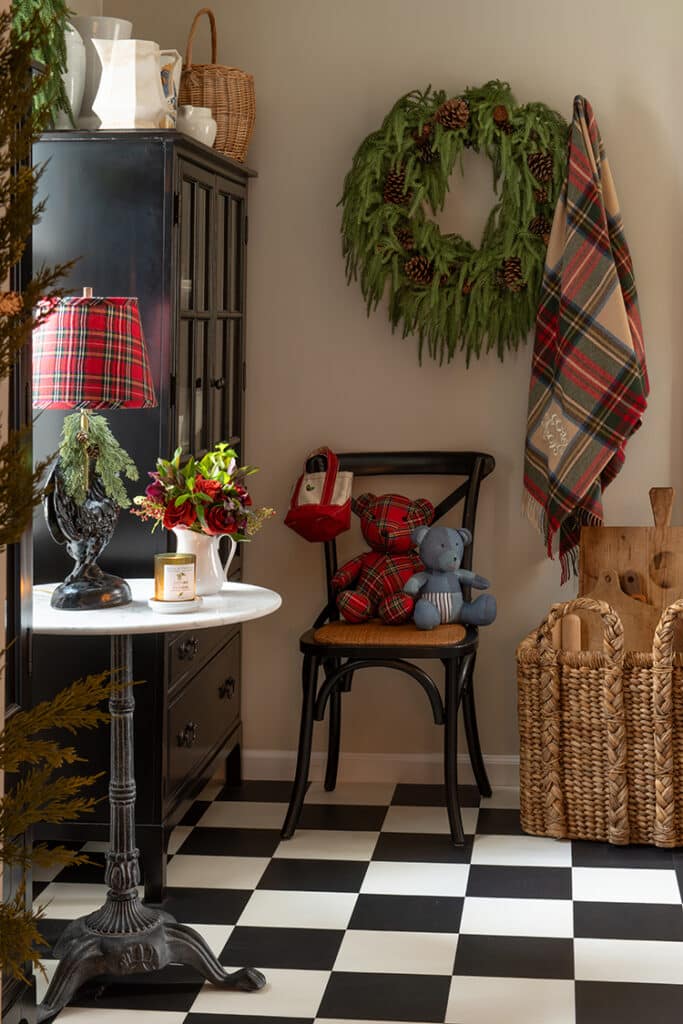
Behind blue-and-white toile curtains, as a nod to the couple’s prioritization for organization, a network of shelves and cubbies was recently installed by California Closets and offers a place for everything, meaning the space never feels cluttered. It’s organization as style—a perfect reflection of the way the Sievers approach both design and daily life.
The Heart of the Home
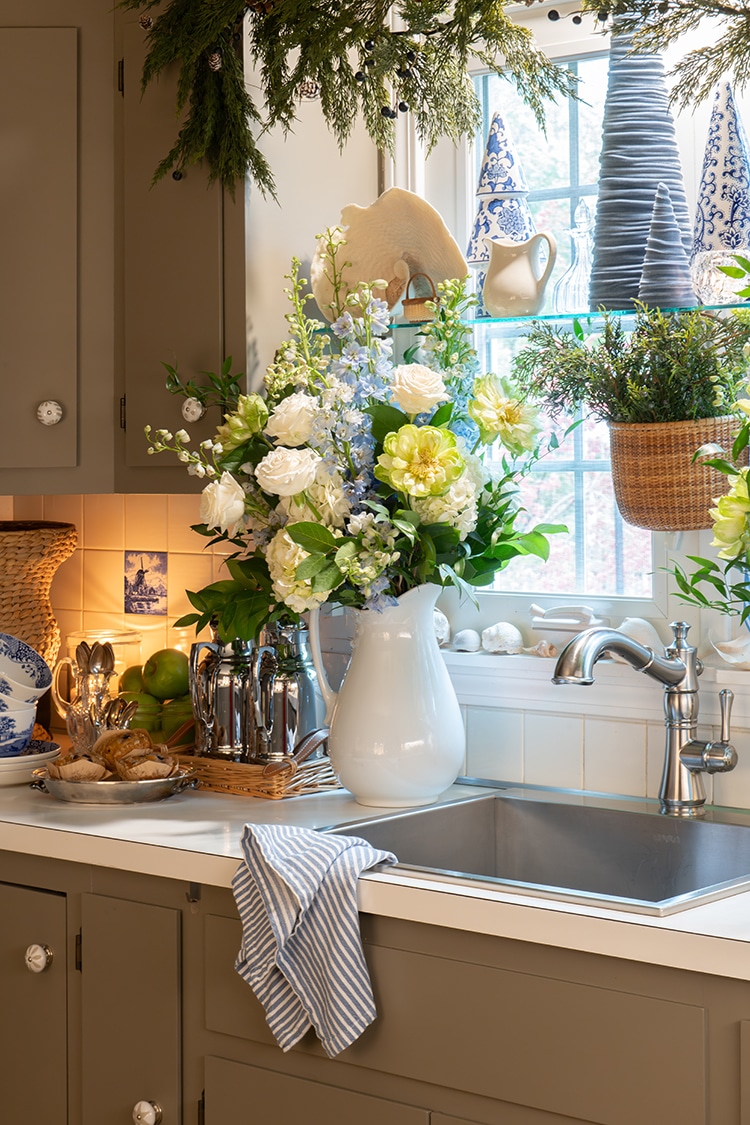
The home’s kitchen is compact but thoughtfully appointed, with painted cabinetry, new appliances, and a commitment to quality fixtures. Above the sink, a slim glass shelf displays coral specimens in summer and blue velvet trees in winter. “I keep the garlands up through February,” Sievers admits. “When it gets dark at 4:30, we all need a little sparkle.” Elements collected on countless trips to France—tins from popular biscuits, various bottles of liqueurs, oils and vinegars—are evocative of a different approach to cooking and living: shop daily, choose only the best and freshest, serve it simply so as to allow the premium quality take center stage.
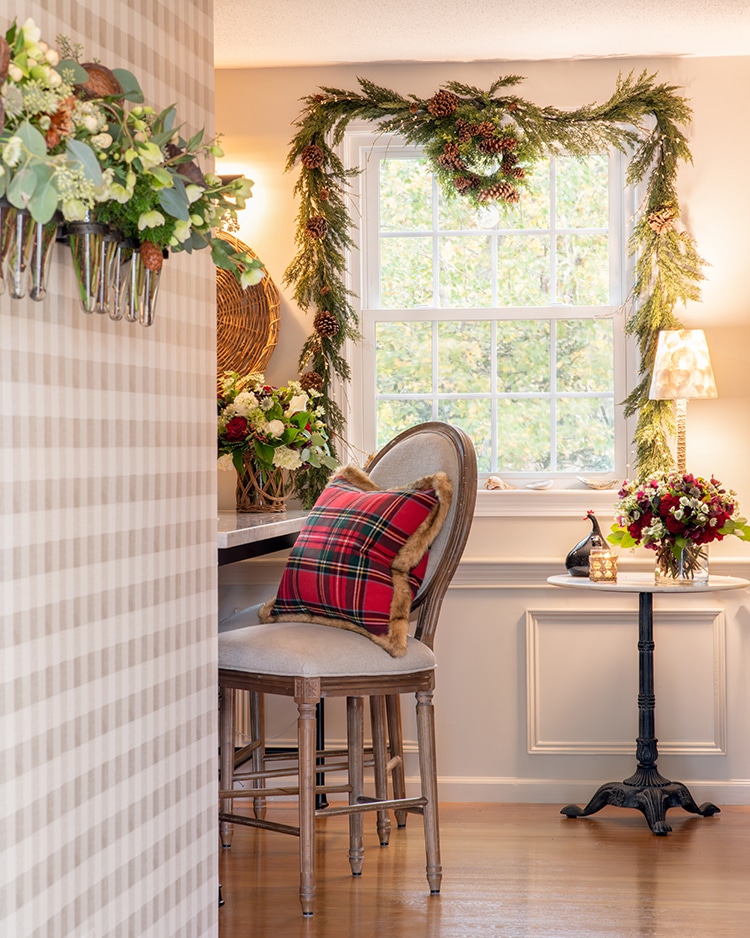
Adjacent to the kitchen is a “pass-through” space that had traditionally been used as the home’s dining room. For the Sievers, it is a very important space that has been thoughtfully appointed to successfully function in a myriad of important ways. A large baker’s rack occupies one wall and display’s the couple’s prized collection of cookware—truly a gourmet’s wish list. In the center of the room a large marble-topped island doubles as a creative workspace where food is prepared and presented; gifts are elegantly wrapped allowing plenty of space to spread out rolls of wrapping paper and yards of ribbon; and upon arriving home, before domestic activities take over, it is the perfect place to open a laptop and spread out with paperwork for a spacious workspace. “We call it The Studio,” Sievers explains. “It’s where I cook, test recipes, create film clips, and even lay out new product ideas for the shop.”
Everything sold at Fête Among the Flowers earns its place by passing through this very space. “Nothing goes onto our sales floor unless I’ve cooked with it, smelled it, enjoyed it, washed it, or used it,” he says. “I want to know how things perform in real life.”
The island has seen everything from recipe testing for Sievers’ cookbooks Table for Two, French Omelettes and Summertime Food, to layout sessions for Ryan’s forthcoming memoir—a project born from Ryan’s experience as a cancer survivor. “His book is about working through that process physically and emotionally,” Sievers says. “He worked throughout his entire battle and actually was promoted during treatment—he turned something terrifying into growth. That’s the spirit that runs through this house too: we make the most of everything.”
The Dining Lounge
If the kitchen is the heart of creativity, the dining lounge is the soul of connection. Part dining room, part salon, the room is dissected for function, yet connected by intention. On one side it is anchored by a long table surrounded by armchairs comfortable enough to linger long past the last course. The other half of the spacious room features two small settees that counterbalance each other, bridged with a low cocktail table, making for an intimate exchange for sips, nibbles and conversation; before and after dinner. “It’s so much more than a dining room,” Sievers says. “We call it a lounge because it’s where the evening unfolds. We have appetizers, then dinner, all in one space.”
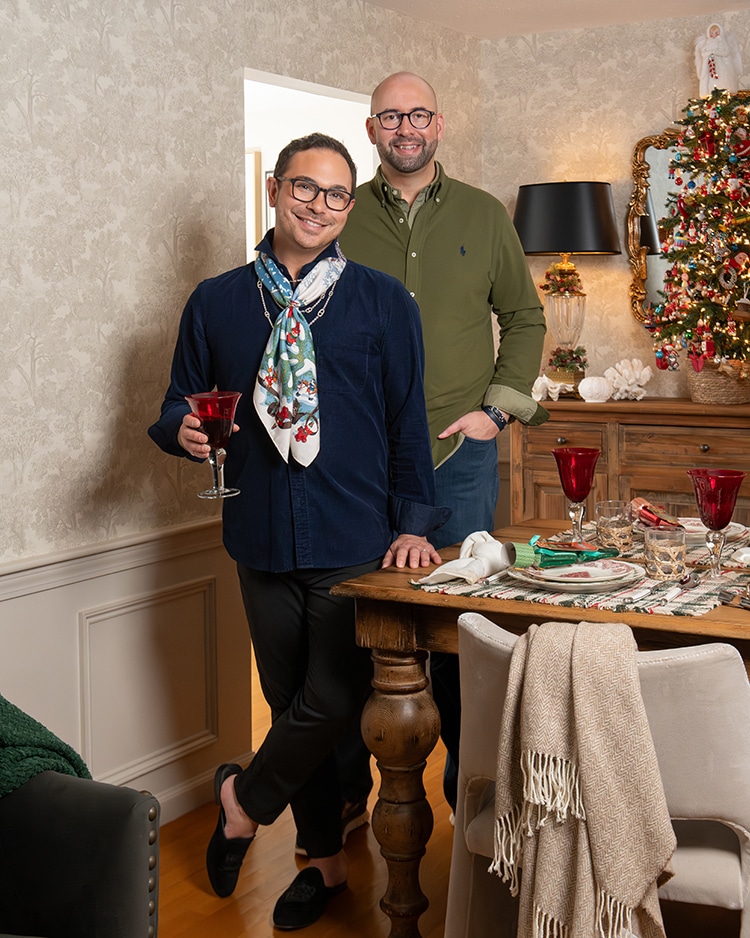
Here, Marc’s style is grounded in contrast: silver bowls filled with potato chips shimmer alongside vintage china; flickering tapers illuminate estate-sale treasures. His blue-and-white collection—pastoral transferware pieces, many mismatched—tells a story of years spent hunting through flea markets, estate sales, and the treasure laden fields of Brimfield.
“I’m not a label person,” he says. “I buy what speaks to me. And I reconsider how things can be used to their greatest value—a bread plate can become an appetizer plate. Nothing is too precious to use.”
For Sievers, entertaining isn’t about perfection. “No one eats five-course meals anymore,” he laughs. “People want to graze, nibble, talk, and stay a while. I’ve been serving potato chips out of polished silver Revere bowls for years. It’s fun—and it always makes people smile.”
That philosophy—perfectly imperfect—extends beyond the table. It’s the through-line of a home designed for living beautifully, not rigidly.
The Library: Where Warmth Glows
At the opposite end of the house, the library glows. Twin sofas embrace a wood-burning fireplace—Sievers’ one non-negotiable when buying a home. “I grew up in apartments and condos,” he says. “I never had a fireplace, and I told Ryan: I don’t care what else the house has, but it must have one.”
The scent of wood smoke has become a nightly ritual. “At the end of the day, after closing the shop, when I pull into the driveway, I can smell the fire,” he says. “That’s when I know I’m home.”
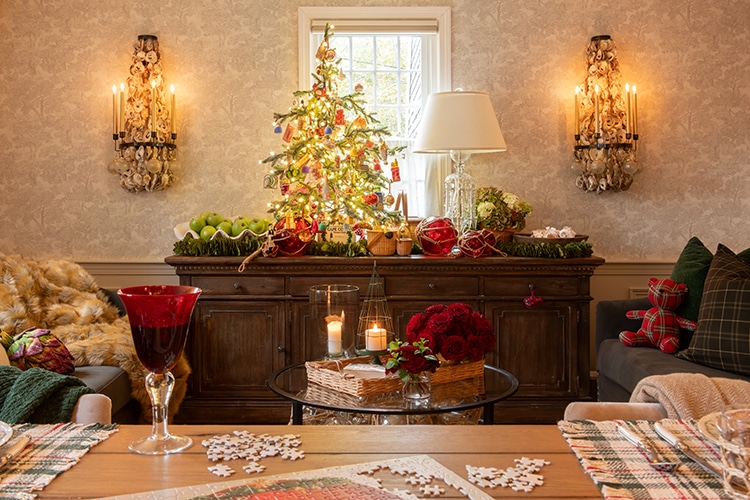
The library’s palette shifts seasonally—coral and shells in summer, tinsel and pine in winter—but the mood always remains intimate. A slim vintage tinsel tree gleams near the doorway, while a towering family tree stretches to the ceiling, heavy with more than 1,500 ornaments collected through their lives together. “That one has everything,” Sievers says. “Ornaments from Ryan’s childhood, from mine, and from our travels. Friends give us ornaments all the time—it’s become a love language.”
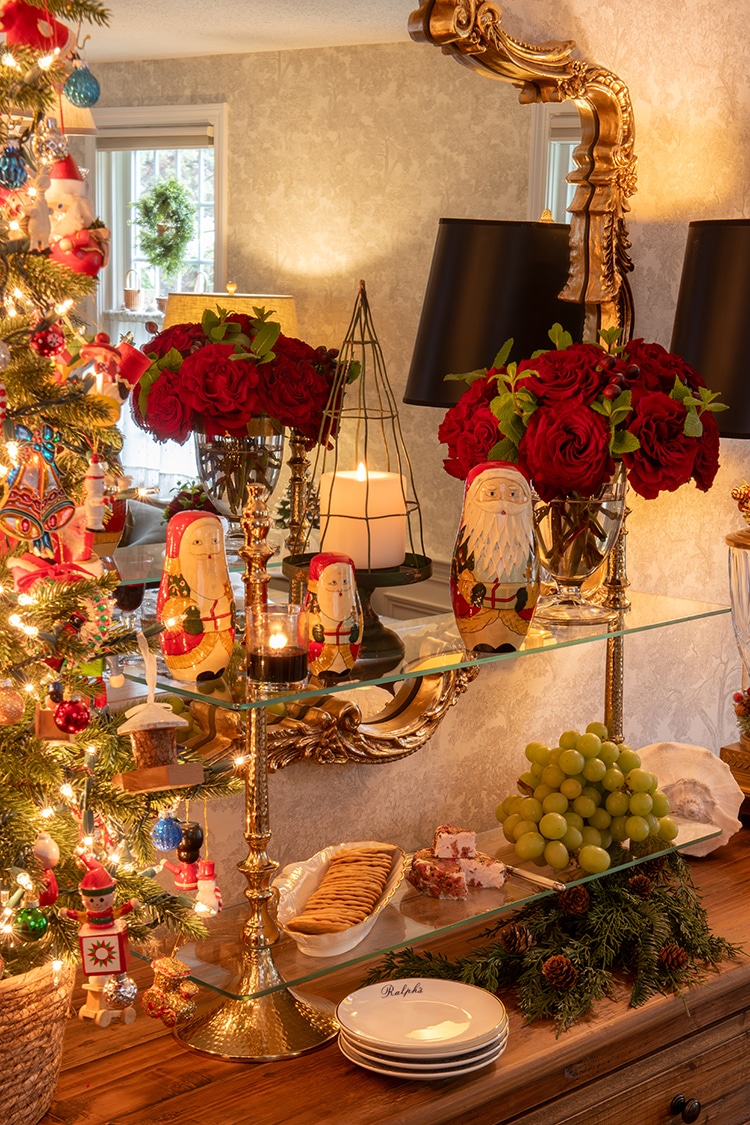
Across the room, a former closet now serves as a petite bar, dressed in wallpaper and brass accents. Nearby, freestanding bookcases form a backdrop for art, lamps, and seasonal décor. “We planned the layout before moving in,” Sievers says. “I wanted the room to feel collected, not cluttered.” Tucked in that end of the room a round table comfortably seats four in low comfortable armchairs where guest snuggle into sheepskin peltss during the cooler months. Whether gathering for a meal, or a competitive round of mahjong, this is the place where secrets and tales of family history spill forth with a sense of abandon.
Perhaps the most charming touch is intentionally unintentional: rose petals dropped from a sumptuous bouquet on a sideboard. “I like things that look like they’ve been lived with,” Sievers explains. “When a few petals fall, it shows time passing. It’s that sense of life happening in a room.”

The Meaning of Celebration
For Sievers, Christmas isn’t a display—it’s a dialogue between memory and imagination. His approach honors tradition but always with a wink toward reinvention. “I love a themed tree, but I don’t want my house to look like a hotel lobby,” he says. “Everything has a story.”
According to Marc, at first, this abundance of a single holiday’s celebration was a bit unfamiliar to Ryan, “When he asked me to move in with him, he said, “I knew you were moving in. What I didn’t know is that Christmas was moving in as well.’”
Vintage ornaments from his grandmother mingle with whimsical finds and hand-painted treasures. His decorations are stored with the same care he gives his floral arrangements: acid-free tissue, ornament chests, and thoughtful wrapping. “Some people think it’s excessive,” he admits, “but these things are part of our family’s story.”
He decorates early and leaves the glow up well past New Year’s. “If it takes five days to decorate,” he laughs, “I’m not taking it down after four weeks. The whole season deserves to be enjoyed.”
Ultimately, “A Season Well Lived” is more than a title; it’s a philosophy. Marc and Ryan have turned a small Cape into a layered canvas for creativity, comfort, and connection—a living expression of who they are and what they love. As Marc says, “I like things that tell a story. This house tells ours.”
Julie Craven Wagner is the editor of Cape Cod HOME.