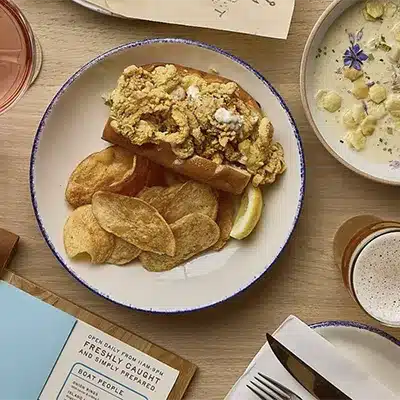
Sebastien Taffara’s education and infatuation with wine began at 15 years old, on the second floor of a brasserie in his native Normandy, France. Four years later, he moved to Paris, laboring as assistant to the wine director under famed French chef Joël Robuchon before heading up the wine program at Le Pergolèse. In Paris, he met Philippe Rispoli, a chef whom he would follow across the pond to Wellfleet. In 2009, the duo opened PB Boulangerie Bistro in Wellfleet. Taffara became the restaurant’s manager and wine steward—selecting the wines for the restaurant, stocking the 1,000-plus bottles in the wine cellar, organizing staff tastings, and arranging special winemaker dinners. Cape Cod Life spoke with the 26-year-old Taffara to uncover some of his personal favorite glasses, how to best pair wine and cheese, and the transition from a cosmopolitan city in France to the majesty of the Outer Cape.
CAPE COD LIFE: What are your observations about the level of wine interest and knowledge of the people who dine at PB?
TAFFARA: The people who come here are really educated about wine and they don’t hesitate to ask questions. Most want to drink French wines and 60 percent of our list is French. Many want to try a wine from Burgundy—rosé is also very popular since it’s a wine for summer. People are very curious and like to discover new wines. One night we opened a six-liter bottle of Gevery-Chambertin and sold it by the glass for $18. It was sold out in two hours. This was a real treat to have an opportunity to buy such a good wine by the glass. We do this in France. People here are very open-minded. They really listen. They ask me what they should order and care about what they’re going to drink. It’s great to share their passion.
Tell us what wines are your personal favorites?
I love the wines from the Rhone Valley. Châteauneuf-du-Pape and Côte Rôtie are very exciting to me. I love to have a glass of Gevrey-Chambertin.
How do you like American wines?
I’m getting more interested in American wines. I like the pinot noirs from Oregon. In France, there is more complexity in the pinot noirs. The region, the climate, the soil make a very big difference, especially in Burgundy. We also bring in Bordeaux blends from California. These types of wines from America are very interesting to drink.
Tell us how to pair wine with cheese. This can be tricky.
Chardonnay goes well with many cheeses. Red wines from Gamay grapes from the Loire Valley or from the Beaujolais region go well with a cheese platter. Goat cheese is fantastic with a glass of Sancerre. Blue cheeses pair very well with a sweet wine, like a Sauternes or Barsac. Roquefort goes very well with a glass of muscat.
Why would you leave your job in Paris to come to work in Wellfleet? That’s a very big change.
I always worked in a restaurant that was established. I never had the opportunity to help open a restaurant, and this was a good opportunity for me. This is why I decided to come to work here. Growing up in Normandy I was used to the countryside. I grew up by the beach—Normandy is the Cape Cod of France. It’s a big change from Paris, but I knew what it was like to live in a small town. You get tired of the city. Here you get to enjoy the beach, the nature. No more subways, there’s less stress, I bike on the bike trail. I’m happy to be here.
- Posted in Wine
Headache-Free Ice Cream
I have made a brilliant discovery. It is not the cure for cancer or a method for getting strawberry stains out of white baby shirts, but it is pretty revolutionary. It is a formula—1 part milk to 2 parts cream to 1/2 part sweetener. It is the secret to incredibly easy and delicious homemade ice cream.
Most homemade ice creams are laborious. First, you make custard, which is a tricky business. You have to heat milk and temper eggs, neither of which is easy to do correctly. One misstep and you have curdled yolks or custard that is thin and watery. The custard is also hot, which means you have to wait patiently for it to get down to 40 degrees before you can finally churn and freeze. Even if you do it right, there is a lot of anxiety.
No more! I have found an ice cream recipe that is easy.
It comes from a Patricia Wells recipe. Tucked into the pages of The Paris Cookbook, there is something called “Maison du Miel’s Heather Honey Ice Cream.” It calls for vanilla beans, heavy cream, milk, and honey. It says to steep the beans in hot milk and cream, then to strain out the seeds and whisk in honey. Chill the mixture like a custard, right down to 40 degrees, and then to pour the thin runny syrup right into your ice cream machine. There is no custard making, no thickening. And the way I make it, there is not even any chilling. This means we need only 30 minutes from ice-cream dreams to reality.
Here’s how it works:
I like my ice cream sweetened with maple syrup. Honey’s okay, especially a very light honey, but you have to heat up the milk to get it to blend, and when the honey is dark it has a very strong flavor. Maple syrup mixes easily with milk and cream, and the taste is subtler. So I stir together 1/2 cup maple syrup, 2 cups heavy cream, and 1 cup milk. That’s it. I pour this into the ice cream maker. It hums away. Twenty-five minutes later we have homemade ice cream! What could be better?
Of course, it’s fun to play with the flavors. This time of year you could do just about anything: blackberry, peach, raspberry. You could steep the milk with rosemary or ginger or even coffee. Whatever you choose, you can’t go wrong. In a few minutes you’ll be digging out a bowl and a spoon, and tucking in to your very own sweet cream flavor.
- Posted in Food
Coastal Al Fresco
Make your Cape Cod summer dining experience special by creating vivid tablescapes.
Summer, the season we wait for all year, is finally here, and the temperature is perfect for dining outside. So why not make your dinners special? Whether you live here or you’re staying at your second home, a beautiful tablescape will help make your dining experience magical. We visited three shops—Design Works of Yarmouthport, Picnic Fashions of Chatham, and Shor Home Furnishings in Provincetown—to help make our settings complete. No matter if it’s a brunch, a dinner for four, or intimate cocktails for two, create an environment that will keep your guests coming back for more!
Red, White, Blue
Inspired by patriotic hues, this color combination for an al fresco brunch is stylish and elegant. A navy blue tablecloth with a nautical rope design by Le Jacquard Francais offers the backdrop to ceramic stoneware and serving pieces from Juliska. Colors are mixed at each place setting, creating that all-American theme. Each setting is topped with a napkin tied with nautical rope for a touch of whimsy and flair. The delicate water glasses and pitcher are also by Juliska. These exquisite pieces are mouth-blown by artisans in the hills outside Prague, Czech Republic. Queen Anne’s lace, blackberry blossoms, and red roses set in a pedestal dish by Juliska complete the ensemble, making everything look almost too pretty to eat! “Whether it be morning, noon, or night, an outdoor setting can create a unique social gathering that family and friends will cherish,” says Margaret Hill, owner of Design Works in Yarmouthport. All settings and accessories are from Design Works in Yarmouthport. / designworkscapecod.com Read more…
Just Peachy
The peach is soft. It is soft and buzz-fuzzed and perfect, and it is still warm in my hands. It reminds me of my daughter—the way her hair grew in after it all fell out, pale blond and furry.
Like Sally, this peach is not just any peach. It is a Peach—our peach, our first peach, a peach that we made from water and sweat, from scratch. It is the one peach that came from the hundreds of pink blossoms that burst out this spring, the one peach from all the compost and mulch and watering. It is hairy and yellow and blushing, and we think it’s perfect, stunning. Read more…
- Posted in Food
A pitcher of sangria contains a fusion of flavors and ingredients—and makes for an ideal warm-weather sipper. The punch-like drink combines red or white wine, juices, spirits, a splash of soda, and chopped fruits. And this thirst-quencher has a lot going for it: the sweetness is a delicious counterpoint to spicy foods, it’s an easy-to-make party drink, and come summertime, the beverage tastes so right alongside seafood and salad. Read more…
Here’s to Sake
At Karen and Sean Terrio’s wedding reception, guests toasted with cups of sake instead of flutes of champagne. It was fitting—the couple had just bought a Japanese restaurant. Now five years later, the Terrios, who own Misaki Sushi in Hyannis, have sipped countless sakes and know much about this ancient drink. “Learning about sake gives me a better understanding of Japanese traditions,” says Karen.
Once known as “the drink of gods,” sake has been around for thousands of years and is made from polished long grains of rice, spring water, yeast, and an enzyme known as koji that aids the fermentation. Although brewed like beer, it’s drunk like a wine.
Starting about three decades ago, new processes let brewers produce premium and artisanal sakes that are usually served cold in a wine glass. The quality is discerned by how much of the outer layers of the grain are polished away—the more polished, the higher the quality and cost. There is a plethora of styles from light and dry, slightly sweet, floral, with tastes of honey, persimmon or squash, to those infused with plums or left unfiltered and creamy. Look for the words Ginjo, Junmai Ginjo, Junmai Daiginjo or Nigori (unfiltered) on labels—these are some categories of the better grades of sake.
Sake bottles in various shapes and colors line the square tables at Misaki when Karen holds tastings with her staff. Calligraphy and sketches of historical Japanese figures, brushed characters, designs of the horizon, crashing waves and flowers, and mottos or poems in Japanese poems decorate the striking labels. The back label gives the sake’s exotic name in English, like Midnight Moon, Pearls of Simplicity, and Dreamy Clouds. While you might think certain French wine labels are hard to decipher, these are nearly impossible to read without learning a few kanji.
The fermented rice drink also makes creative cocktails. Shake with spirits and juices, and you have a saketini. Dump a hot ochoko – a tiny cylindrical cup used to serve sake – into a cold glass of beer and you have a sake bomb. ” Sake has become more trendy than ever before,” says Karen. (She still sometimes enjoys sipping the traditional warm cup of sake. “Its soothing.”)
From Hamada San, the restaurant’s Japanese sushi chef, the couple learned about sake etiquette. For example, the Japanese never pour their own sake when dining with other people. It’s up to a dining partner to fill another’s glass. “Understanding these rituals gives me a better understanding of this history” says Karen. ” There’s a lot to learn.”
- Posted in Wine
A Fine Wine & Dine on Nantucket
World class wines from France. Fresh oysters from Duxbury. Black bass caught off the coast of Nantucket. Superb salmon flown straight from Scotland. Fine cuts of lamb from Colorado. Black truffles ordered from Paris. All prepared and served by highly regarded chefs and sommeliers in an elegant Nantucket home on a lovely summer evening.
These were just some of the attractions for a “Great Wines in A Grand House” dinner held last summer as a premiere 2011 Nantucket Wine Festival event. The evening was a star-studded extravaganza created by well-known chef, Robert Sisca of Boston’s award-winning Bistro du Midi, several French winemakers, and a Nantucket couple who shared their historic home with 18 lucky guests. Read more…
- Posted in Social LIFE, Summer, Traditions, Wine
With Memorial Day right around the corner, it’s time to start thinking of light and easy meals created with fresh natural ingredients. We asked Cape Cod Life’s staff to share their favorite salad recipes to give you a head start on great summer salads!
Annual Guide Outtakes: “Here’s my beer. What do you think?”
As I mentioned last week, I’m going to be posting bits and pieces that, due to space constraints, didn’t make it into the 2012 Annual Guide. In this outtake, Todd Marcus, brewmaster at Cape Cod Beer, talks about how he cleaned draught lines to get his foot in the door, the brewery’s community-first ethos, and why I shouldn’t have tossed my plastic cup in the trash after a beer tasting.
I usually say I was gathering intelligence along the way (while I was working for Hyannisport Brewing Company). I even went so far as to work part-time for another local business that was involved in draught line cleaning so I could get into these bars and restaurants on the Cape, talk to the managers and bartenders, learn about their draught systems, what worked and didn’t work, what they liked in the beers that were on tap and what they didn’t like. It allowed me some nice ins later on, after Hyannisport Brewing Company closed, when I would say, “Remember when I was here to clean your draught lines and said that I was thinking about opening a brewery some day? Well, here it is, here’s my beer. What do you think?”
Cape Cod Beer started with Red and IPA. Originally, you could only get the IPA if you had the Red on tap. Having the Red and IPA together meant that if a customer tried the IPA and didn’t like it, but they were still somebody who was interested in trying a craft beer, that they’d try the Red and they’d be happy and satisfied with it. To this day, Cape Cod Red still accounts for more than half of our sales.
Recycling is huge for us—it’s a major part of who we are. We typically put out about one big black bag of trash from the brewery every week. Just about everything else from here gets recycled—all of our plastics, all of our metals. To be perfectly honest, I’m going to go pick up that plastic cup you threw in the trash on the way in here and I’m going to put it in the recycling bin. It’s not your fault. It’s just one of the things I’m going to do.
People know that if they’re going to drink our beer, that money they spent is going to stay here on Cape Cod. I’m going to get my paycheck and I’m going to go to the local hardware store, the local jeweler, the local optician. What comes around goes around.
If you look at our brewery’s retail shop—the books, the candles, the coffee, all that stuff—75 cents of every dollar we spent on retail items last year went to someone on Cape Cod. Now, nobody on Cape Cod is combing cotton to make a T-shirt obviously, but at the very least we’re using local screenprinters, local embroiderers, and as many locally sourced items as we can. We’re a great tourist destination, and we’re trying to help these cottage industries by giving them an outlet. We want to say, “We appreciate what you’re doing, trying to live here and enjoy what Cape Cod has to offer, and that you’re trying to make a living doing what you love as well.” Hopefully, as a result, those people are drinking Cape Cod Beer.
- Posted in Blogs, Food, Jeff Harder's Blog
Growing Gourmets
Many of us wish we could develop a new skill—such as learning to cook like a veritable gourmet chef. And we’re in luck: The Regatta of Cotuit offers just such a cooking class series taught by its chef-owner Weldon Fizell.
- Posted in Arts & Culture, Family Fun, Food